Last Updated: November 9, 2026
Quick Summary
Acupuncture for recovery after intense weightlifting is best used as an add-on to sleep, nutrition, and load management, not a replacement. Book sessions 24 to 48 hours after your heaviest session, not the day before a max attempt, and expect modest, short-term relief of soreness and tightness.
- Routine DOMS is symmetrical, peaks 24 to 48 hours after training, and fades within 72 hours.
- Book a session when soreness lingers more than 3 to 4 days or limits range of motion.
- Avoid deep trigger-point work the day before a heavy squat, deadlift, or overhead press.
- Wait 24 to 48 hours before heavy lifting after a session targeting deep muscle tissue.
- If nothing changes after 3 sessions, the treatment is not the right tool for that problem.
Table of Contents
- Why Your Muscles Stay Sore After Heavy Lifting
- Acupuncture for Delayed-Onset Muscle Soreness: What the Evidence Shows
- How Acupuncture for Muscle Knots Works on Tight, Tender Tissue
- Acupuncture for Weightlifting Injuries: When to Book a Session
- A Practical Recovery Protocol for Lifters
- Exercise After Acupuncture: How Soon Can You Train Again?
- How Acupuncture Compares to Standard Recovery Options
- Book a Recovery Session at Source Acupuncture
- Frequently Asked Questions
Why Your Muscles Stay Sore After Heavy Lifting
Your muscles stay sore after heavy lifting because intense exercise creates tiny tears in muscle tissue, and the repair process triggers inflammation, swelling, and stiffness that peak a day or two later. This is called delayed-onset muscle soreness, or DOMS. It is a normal part of training, not a sign you did something wrong. (Source: the National Institutes of Health’s National Center for Complementary and Integrative Health (NCCIH))
Lifters who train hard often find that soreness lingers, tightness never quite clears, and the next session suffers.
Here is what most guides get wrong: soreness is not just a feeling. It reflects real tissue stress, reduced range of motion, and slower strength recovery.
The good news? Recovery responds to the right inputs. Below, we break down how acupuncture for recovery after intense weightlifting fits into a smart training plan, what the evidence actually shows, and how to time sessions around your lifts.
Acupuncture for Delayed-Onset Muscle Soreness: What the Evidence Shows
The evidence on acupuncture for delayed-onset muscle soreness is best described as mixed and modest. Some trials report reductions in soreness and improvements in range of motion after strenuous exercise, while others find effects close to placebo or too small to matter. The honest take for lifters: the research is mixed, and it does not support treating acupuncture as a substitute for sleep, nutrition, or load management.
What the research actually measures
A key problem in this literature is that different studies measure different things and then get summarized as if they measured the same thing. The main outcome categories are:
- Pain or soreness ratings: Self-reported scales, often 24 to 72 hours after exercise. These are the most common outcome and the most susceptible to placebo effects.
- Range of motion: Goniometer or similar measurements of how far a joint moves. Improvements here are more objective but often small.
- Strength recovery: Force output or peak torque measured after exercise. Fewer studies measure this, and results are inconsistent.
When you see a claim that acupuncture ‘helps recovery,’ ask which of these outcomes changed. A study showing improved perceived recovery is not the same as a study showing faster strength recovery or reduced injury risk.
How certain is the evidence?
Research on this topic is limited in several ways. Common limitations in the research include:
- Small sample sizes, often a few dozen participants or fewer
- Difficulty blinding participants, since they can feel whether needles are inserted
- Inconsistent treatment protocols, including different points, needle retention times, and number of sessions
This does not mean the findings are wrong. It means the effect is not established with the confidence you would want before making strong claims. Some people may experience short-term relief, and risks are generally considered low when treatment is performed by a licensed practitioner. Talk with a qualified professional about whether it is appropriate for you.
Realistic effect sizes for lifters
Some people report that acupuncture may take the edge off soreness, improve comfort with movement, and help a tight region feel looser. In general terms, that might mean:
- Soreness that peaks at a lower level than it otherwise would
- A restricted squat feeling closer to normal
- A day or two of improved comfort during the recovery window
Improvements of this kind may matter during a hard training block, but they are not the same as faster tissue repair or increased strength. If you are weighing the full picture, our article on whether acupuncture helps with delayed onset muscle soreness digs into the research in more depth.
The National Center for Complementary and Integrative Health overview of acupuncture is a useful starting point for understanding what the evidence supports and where gaps remain. It is also a good reminder that ‘may help’ and ‘is proven to help’ are different claims.
How Acupuncture for Muscle Knots Works on Tight, Tender Tissue
Acupuncture for muscle knots targets trigger points, the small, tender bands of tight muscle tissue that form after repeated strain.
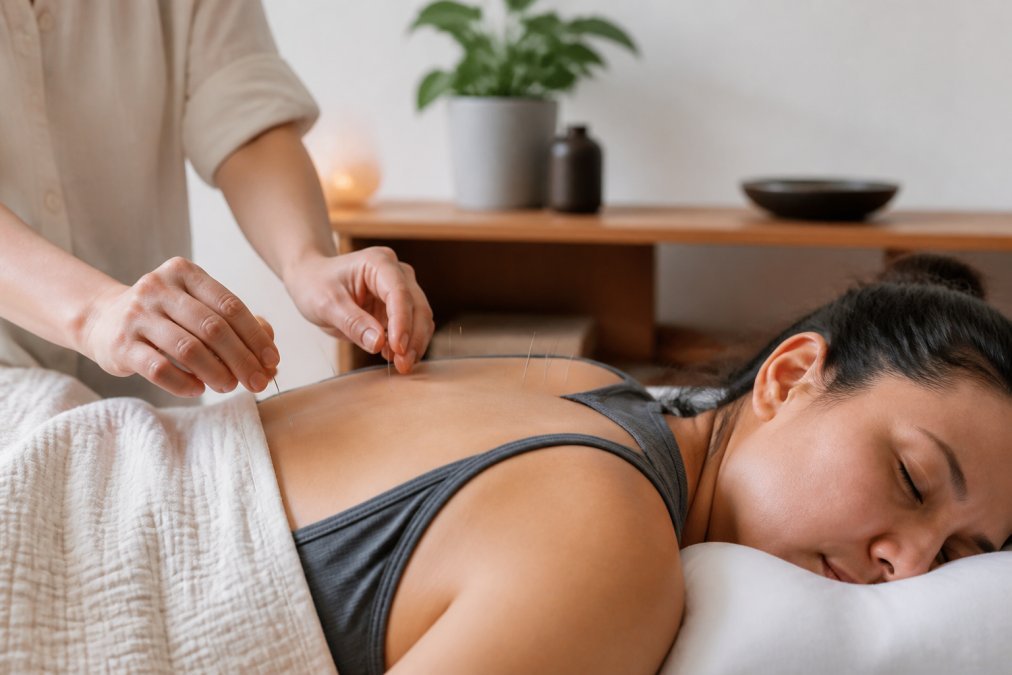
Here is what happens in practice:
- The practitioner palpates the muscle to find tight, tender areas.
- Fine needles go into those points, often with a brief twitch response.
- Blood flow and oxygen delivery to the muscle improve.
- Many people report the muscle feels looser and less stiff afterward.
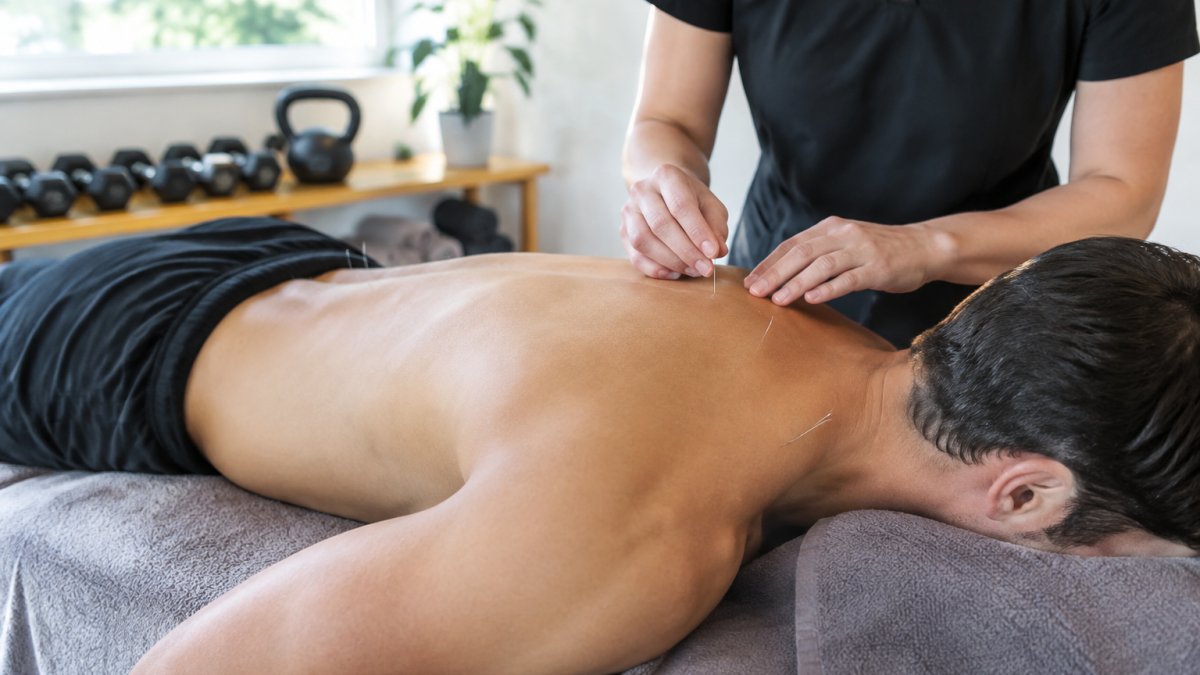
Lifters often carry knots in the upper back, traps, and glutes. These areas take load during squats, pulls, and presses.
Watch out: needles should only go into trained hands. A licensed practitioner knows depth, angle, and which structures to avoid.
Acupuncture for Weightlifting Injuries: When to Book a Session
Book a session for a weightlifting injury when pain persists beyond a few days, limits your range of motion, or keeps you from training normally. When low back strain lingers or becomes a recurring concern, acupuncture for chronic back pain may be worth discussing with a qualified clinician as part of a broader recovery plan.
Signs it is time to book:
- Soreness that lingers more than 3 to 4 days
- Joint pain that worsens with load
- Stiffness that limits depth in squats or overhead reach
Signs to see a doctor first:
- Sharp, sudden pain during a lift
- Numbness, tingling, or weakness
- Swelling that does not improve
If you are unsure, get assessed. Our guide to acupuncture for sports injury recovery walks through how treatment fits alongside standard care. (Source: the physiological processes involved in muscle damage and repair)
A Practical Recovery Protocol for Lifters
A practical recovery protocol for lifters is not a fixed calendar. It is a set of decision rules you apply to each training week based on how your tissue is responding to load. The framework below is built around the two variables that matter most for lifters: training phase and soreness pattern.
Step 1: Classify the soreness before you book anything
Not all post-lift soreness is the same, and the right response depends on which pattern you are in.
- Routine DOMS: Symmetrical, diffuse, peaks 24 to 48 hours after training, fades within 72 hours, and improves with light movement. This is normal and does not require treatment.
- Persistent tightness: A specific region (upper traps, glutes, low back) stays tight for more than 3 to 4 days and limits range of motion even when the rest of the body feels recovered. This is the pattern where acupuncture for recovery after intense weightlifting is most commonly used.
- Injury signal: Sharp pain, pain that worsens with load, numbness, tingling, weakness, or a pop or snap during a lift. Stop training that pattern and get assessed before booking bodywork.
A common pattern practitioners see: lifters book a session for what they assume is DOMS when the real issue is a minor strain that needs load modification first. If the soreness is asymmetrical or worsens with each session, treat it as an injury signal, not a recovery problem.
Step 2: Time sessions to your training phase
How often you book depends on where you are in your training cycle.
| Training phase | Typical soreness pattern | Reasonable acupuncture timing |
|---|---|---|
| Off-season or base building | Low to moderate, predictable | Every 2 to 4 weeks as maintenance |
| Hypertrophy block | Moderate, accumulates across the week | Once weekly, ideally on the day after your heaviest session |
| Peak strength or meet prep | High, concentrated around heavy singles | 24 to 48 hours after the heaviest session, not the day before a max attempt |
| Deload week | Low | Skip unless a specific area is still tight |
Two rules of thumb that hold up in practice:
- Do not book a deep trigger-point session the day before a heavy squat, deadlift, or overhead press. Treated tissue can feel heavy or sore for 24 hours, and you want that window to fall on a light or rest day.
- Book the session after the soreness peak, not during it. Most lifters find the 48-to-72-hour window, when acute swelling has settled but tightness remains, is the most productive time to treat.
Step 3: Build the non-negotiable recovery base first
Acupuncture is one input. The inputs below do more of the work, and skipping them makes treatment less effective.
- Sleep: 7 to 9 hours. This is the single largest recovery lever and the one most lifters shortchange.
- Protein: A common target is roughly 0.7 to 1 gram of protein per pound of body weight per day for lifters in a hard training block. Spread it across 3 to 5 meals.
- Hydration: Urine should be pale yellow. Dehydration worsens stiffness and perceived soreness.
Step 4: Track outcomes, not just soreness
Soreness is subjective and influenced by sleep, stress, and motivation. Track three things instead:
- Range of motion: Can you hit depth in a squat or reach overhead without compensation?
- Strength recovery: Are your working weights holding steady or climbing session to session?
- Return to training: How many days until you can train the same pattern at full load?
If acupuncture is helping, you should see improvement in at least one of these within 2 to 3 sessions. If nothing changes after 3 sessions, the treatment is not the right tool for that problem, and the plan should change.
For a deeper plan on the non-acupuncture side, our guide on how to speed up muscle recovery after workout covers nutrition, sleep, and active recovery in detail.
Exercise After Acupuncture: How Soon Can You Train Again?
Most people can return to light exercise the same day or the next day after acupuncture. For heavy lifting, wait 24 to 48 hours, especially if the session targeted deep muscle tissue or trigger points.
General timing:
- Light movement or walking: same day
- Moderate training: next day
- Heavy lifting: 24-48 hours
Listen to your body. If you are planning your return, our article on how to create an effective active recovery plan helps you structure the week so you do not lose momentum.
How Acupuncture Compares to Standard Recovery Options
Acupuncture can be considered as an add-on to standard recovery options, but it is not a replacement for sleep, nutrition, or load management.
| Option | Best For | Limits |
|---|---|---|
| Acupuncture | Soreness, tightness, circulation | Needs a licensed practitioner |
| Massage | Muscle tension, relaxation | Temporary relief |
| Foam rolling | Self-care, mobility | Less targeted |
| Sleep | Full-body repair | Requires consistency |
| Nutrition | Tissue repair, energy | Needs planning |
Acupuncture is often described as targeting specific points, with some practitioners citing effects on circulation and blood flow to muscle tissue.
If you are deciding between hands-on options, our comparison of acupuncture vs massage for muscle recovery breaks down the differences.
Book a Recovery Session at Source Acupuncture
Book a recovery session at Source Acupuncture when soreness, tightness, or lingering pain is slowing your training.
What you can expect:
- Personalized care from licensed practitioners
- A blend of traditional techniques and modern therapies
- A wellness membership program
You do not have to train through the soreness. Get assessed, get a plan, and get back to lifting with confidence. Contact Source Acupuncture to learn more about recovery support options.
Soreness that never clears is a signal, not a badge of honor.
Frequently Asked Questions
Can acupuncture help with muscle soreness after weightlifting?
Research on acupuncture for recovery suggests it may reduce the intensity of delayed-onset muscle soreness (DOMS) and help you return to training sooner. Treatment approaches vary, and sensations differ from person to person. Results vary, so treat acupuncture as one part of a recovery plan that includes sleep, protein intake, and hydration. If soreness lasts more than a week or comes with sharp pain, get assessed before your next heavy session.
When should I get acupuncture after an intense workout?
Timing is a question to discuss with a qualified practitioner based on your training schedule. Some lifters book a session the day after a heavy leg day, while others wait until the second day when stiffness is worst. If you are using acupuncture for delayed-onset muscle soreness, a single session in that window is a reasonable starting point. Your practitioner can adjust the plan based on your training schedule and how your body responds.
How long should I wait to lift weights after acupuncture?
Most people can return to light training the same day and full lifting within 24 hours, but this depends on the treatment. If you had needles in a specific injured area or received cupping alongside acupuncture, your practitioner may suggest 24 to 48 hours of rest for that muscle group. For exercise after acupuncture, start with a warm-up and pay attention to how the area feels. Avoid maximal lifts immediately after a session, and ask your practitioner for a specific return-to-training timeline.
How many acupuncture sessions might be needed for workout-related soreness?
For occasional post-workout soreness, one or two sessions may be enough to take the edge off. For recurring muscle knots or weightlifting injuries, a short series of four to six sessions over a few weeks is common, with spacing based on your training calendar. Chronic issues often respond better to consistent treatment than to a single visit. Source Acupuncture offers a wellness membership with discounted services; ask about current pricing and scheduling when you book.