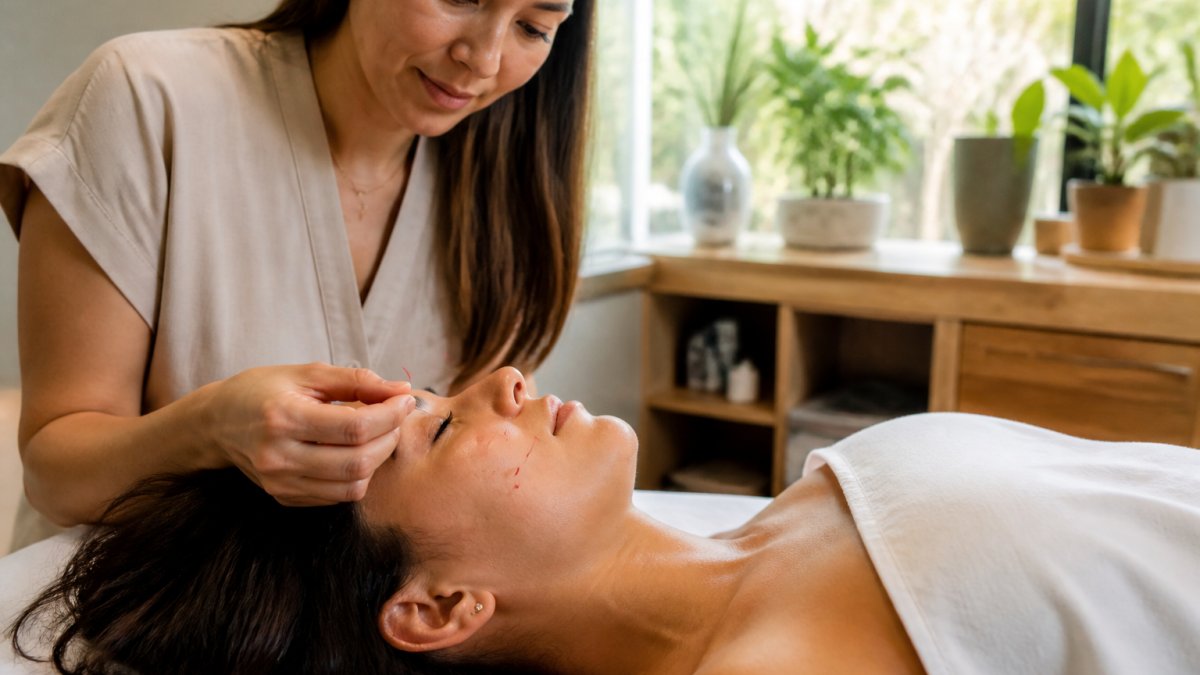

The main types of acupuncture include traditional Chinese acupuncture, dry needling, cosmetic acupuncture, auricular acupuncture, electro-acupuncture, Japanese acupuncture, and trigger point acupuncture. Each one works a little differently, so the right pick really comes down to what you’re hoping to treat.
Acupuncture is not one-size-fits-all, and the research backs that up: a large review of acupuncture trials found that it outperformed both sham treatment and no treatment at all for chronic pain. What that tells us in practice: a technique built for muscle tension won’t necessarily calm anxiety or smooth out skin tone, and the reverse is true too.
That’s why, here at Source Acupuncture, we always start by asking about your goals and health history before recommending a style, rather than defaulting to the same approach for everyone.
Here’s a straightforward breakdown of the seven most common types so you can walk into your first appointment feeling confident, not confused.
Key Takeaways
- Acupuncture isn’t one style. It’s seven, and each one, traditional Chinese, dry needling, cosmetic, auricular, electro-acupuncture, Japanese, and trigger point, is built for a different kind of relief.
- Traditional Chinese acupuncture treats the whole body, while dry needling targets specific muscle tightness. The two come from different training backgrounds and different philosophies entirely.
- Cosmetic acupuncture can improve skin tone and elasticity, but it takes a series of sessions, usually six to ten, before the changes are really noticeable.
- Auricular and electro-acupuncture are often used to strengthen results from other treatments, whether that’s easing anxiety or reaching nerve pain that hasn’t responded to needles alone.
- Japanese-style acupuncture uses a lighter touch, making it a solid starting point if you’re nervous about needles or new to treatment altogether.
- The best way to know which type is right for you is a real conversation about your health history, not guesswork, which is exactly how we approach it at Source Acupuncture.
1. Traditional Chinese Acupuncture: Whole-Body Relief and Balance
Traditional Chinese acupuncture is the original style, and it’s the foundation almost every other type is built on. A licensed acupuncturist inserts thin, sterile needles into specific points along the body’s meridians, with the goal of getting your qi (pronounced “chee”), or natural energy, flowing the way it’s supposed to. It also treats you as a whole person, not just the symptom that brought you in.
Someone dealing with chronic lower back pain in North Park, for example, might also get points for stress or digestion, since traditional Chinese medicine treats those systems as connected rather than separate.
A typical visit includes:
- Needles placed at points tied to your specific concern, not just wherever it hurts
- A pulse check and tongue observation before treatment starts, both used to read what’s going on internally
- Sessions that typically run 45 to 60 minutes
- Follow-up questions about sleep, stress, digestion, and mood, since these systems are treated as connected
If you’re new to acupuncture, this is usually where we start. It’s a solid entry point for pain, anxiety, sleep issues, or hormonal imbalances, and it gives us a clear picture of what else might be going on before we get more targeted.
2. Dry Needling: Targeted Relief for Muscle Pain and Sports Injuries
Dry needling targets tight muscle bands called trigger points, and physical therapists or sports medicine practitioners are the ones who typically perform it, rather than licensed acupuncturists. The needles themselves are identical to what’s used in traditional acupuncture, but the theory behind the technique comes from Western anatomy and neuromuscular science rather than traditional Chinese medicine.
A typical approach involves:
- Best suited for athletes and active people, like a surfer dealing with shoulder impingement from paddling out at Ocean Beach
- Needles inserted directly into the muscle knot, with relief that can come quickly, sometimes in a single session
- Often paired with physical therapy exercises to speed up recovery
- Different training than acupuncture requires: licensed acupuncturists complete three to four years of graduate-level study, while dry needling certifications for non-acupuncturists vary widely in depth
We offer dry needling right alongside our acupuncture services at Source Acupuncture, so if a sports injury like this sounds like your situation, you don’t need to go anywhere else to get it. If muscle tightness isn’t your main concern, though, cosmetic acupuncture works toward something else entirely.
3. Cosmetic Acupuncture: A Natural Approach to Skin Tone and Aging
Cosmetic acupuncture uses ultra-fine needles in the face to stimulate circulation and collagen production, which is what improves skin tone and softens fine lines over time. It’s a non-injectable alternative to treatments like Botox, and it’s grown especially popular in San Diego’s wellness-focused pockets, from La Jolla to South Park. Facial acupuncture has been linked to real improvements in skin elasticity, which is part of why more people are turning to it as a non-invasive option.
At Source Acupuncture, a session includes:
- A holistic consultation covering lifestyle factors before any needles go in
- Facial acupuncture at precise points, plus body points that support skin health from the inside, like digestion, stress, and hormonal balance
- Optional add-ons like facial massage or gua sha for extra circulation
- Herbal guidance to help results carry over between visits
We usually recommend 6 to 12 weekly sessions to start, then monthly visits to maintain results, though most people notice a healthy glow even after the first appointment. If skin isn’t really what’s driving you toward acupuncture, auricular acupuncture takes a completely different approach, working through the ear to calm the whole body.
4. Auricular Acupuncture: Ear-Based Treatment for Stress and Recovery
Auricular acupuncture treats the whole body through specific points on the ear. The ear works as a microsystem, meaning different zones of the outer ear correspond to different organs and systems elsewhere in the body.
This style shows up most often in:
- Addiction recovery and mental health programs, using the NADA protocol, a standardized five-point ear treatment used in community clinics and group settings, including several programs in San Diego County
- Stress and anxiety relief, since needles placed only in the ear mean it can be done seated and in a group setting at a lower cost
- An add-on to a full-body session, often layered in to help with sleep or cravings
Because it’s so low-key, we’ll frequently work a few ear points into the end of a regular session rather than treating it as a separate visit. If nerve pain or a stubborn injury is more what you’re dealing with, electro-acupuncture adds a layer of stimulation that auricular points alone don’t offer.
5. Electro-Acupuncture: Extra Stimulation for Nerve and Chronic Pain
Electro-acupuncture connects small electrodes to the needles once they’re placed, sending a gentle electrical current between them to add extra stimulation. The sensation is a mild, rhythmic pulse, and the intensity is always kept at a comfortable level.
It’s most commonly used for:
- Sciatica, nerve damage, and post-surgical recovery
- Cases where standard acupuncture alone hasn’t delivered lasting relief, since the current mimics the repeated manual stimulation a practitioner would otherwise do by hand
- Chronic pain that needs more consistent stimulation than manual technique alone can deliver throughout a session
If chronic pain hasn’t responded to needles by themselves, electro-acupuncture is usually the next step worth trying before assuming acupuncture just isn’t a fit for you. Japanese acupuncture, on the other hand, goes in the opposite direction, using an even lighter touch for people who want a gentler introduction.
6. Japanese Acupuncture: A Gentler Option for Sensitive Patients
Japanese acupuncture uses finer needles and a lighter touch than its Chinese counterpart, which makes it a good fit if you’re sensitive, anxious about needles, or brand new to treatment altogether. The diagnostic approach is different too, leaning more on palpation, feeling the abdomen and specific body channels for subtle changes in texture and tension, rather than pulse and tongue alone.
What sets a session apart:
- A gentler insertion technique where the needle barely penetrates the skin
- Diagnosis built around touch, not just observation, to catch tension patterns before they become obvious
- A common entry point for San Diego residents who’ve avoided acupuncture because they’re nervous about pain
Shallower needles don’t mean a weaker result. Precision of placement and how closely a practitioner reads your body’s response are what drive the outcome, not needle depth. If your pain is more localized, a tight muscle with a clear trigger point, trigger point acupuncture takes a more direct approach to the same goal.
7. Trigger Point Acupuncture: Relief for Tight, Referred Muscle Pain
Trigger point acupuncture targets knotted, hyper-irritable spots in muscle tissue that refer pain to other areas of the body. Unlike dry needling, it’s performed by licensed acupuncturists and blends traditional diagnostic methods with precise anatomical targeting.
It’s a strong option for:
- Headaches from neck and shoulder tension, jaw pain, or muscle tightness that hasn’t resolved with stretching or massage
- Pain patterns where the needle goes directly into the trigger point, often causing a brief involuntary twitch that signals the tissue releasing
- Cases where one well-placed needle brings faster relief than broader approaches, especially when the pain has stuck around for months
This is one of the styles we perform ourselves as licensed acupuncturists, right alongside the dry needling we also offer, so if you’re not sure which one fits your situation, we can sort that out together at your first visit. Between all seven styles, the differences really come down to training, technique, and what you’re trying to treat, which is where the comparison below can help.
Which Type of Acupuncture Is Right for You?
Choosing the right type comes down to your main concern, how sensitive you are to needles, and what kind of results you’re after. The table below is a quick side-by-side to help you think it through.
| Type | Best For | Needle Depth | Session Length |
| Traditional Chinese | Whole-body health, chronic conditions | Moderate | 45–60 min |
| Dry Needling | Muscle pain, sports injury | Deep | 20–30 min |
| Cosmetic | Skin tone, fine lines, anti-aging | Shallow | 60–75 min |
| Auricular | Stress, addiction, PTSD | Very shallow | 20–45 min |
| Electro-Acupuncture | Nerve pain, chronic pain | Moderate | 30–45 min |
| Japanese | Needle-sensitive patients | Very shallow | 45–60 min |
| Trigger Point | Referred pain, tight muscles | Moderate–deep | 30–45 min |
Session length and needle depth vary by practitioner and treatment plan. This table reflects typical ranges, not guarantees.
Think of this as a starting point, not a final answer. A licensed acupuncturist can assess your specific situation, and it’s common to combine more than one style in a single session, which is exactly the kind of call we help you make at your first visit.
Find the Right Acupuncture Style in San Diego
Traditional Chinese, dry needling, cosmetic, auricular, electro-acupuncture, Japanese, and trigger point acupuncture each serve a distinct purpose, and none is objectively “better” than the others, just better suited to specific goals. Knowing the difference means you can walk into a first appointment with real questions instead of guesswork, and set expectations that match what the style you choose can realistically deliver.
Schedule Your Visit at Source Acupuncture
At Source Acupuncture, we’re two licensed acupuncturists who take the time to understand your health history before recommending a style, not just default to whatever’s fastest.
If any of these seven types sound like a fit, or you’re still not sure which one is, call us at (619) 761-9544 or book directly online. We offer dry needling and cosmetic acupuncture right alongside traditional treatment, so most patients get everything they need in one place.
Frequently Asked Questions
What are the main types of acupuncture available in San Diego?
The main types of acupuncture available in San Diego include traditional Chinese acupuncture, dry needling, cosmetic acupuncture, auricular acupuncture, electro-acupuncture, Japanese acupuncture, and trigger point acupuncture. At Source Acupuncture, we offer several of these directly, including dry needling and cosmetic acupuncture, right alongside traditional treatment.
What is the difference between acupuncture and dry needling?
The difference between acupuncture and dry needling comes down to training and theory. Acupuncture is practiced by licensed professionals with graduate-level training in traditional Chinese or Japanese medicine, while dry needling is typically performed by physical therapists or chiropractors using a Western anatomical model. Both use thin needles, but the diagnostic approach and treatment goals are different. We’re licensed acupuncturists who also offer dry needling in San Diego, so you don’t have to choose between providers if you’re not sure which one fits.
Is cosmetic acupuncture effective for reducing wrinkles?
Cosmetic acupuncture is considered effective for reducing the appearance of fine lines and wrinkles, though results vary by individual and the research is still early-stage. Facial acupuncture has been linked to real improvements in skin elasticity after a series of sessions. At Source Acupuncture in San Diego, we typically recommend six to twelve treatments for noticeable results, followed by monthly maintenance.
Which type of acupuncture is best for anxiety and stress?
Auricular acupuncture and traditional Chinese acupuncture are typically considered the best options for anxiety and stress, since both calm the nervous system in different ways. Auricular acupuncture, specifically the NADA five-point protocol, is widely used in mental health and recovery settings across San Diego County. Traditional Chinese acupuncture addresses stress by treating related patterns involving the liver, heart, and nervous system as a whole.
How do I know which type of acupuncture is right for my condition?
Knowing which type of acupuncture is right for your condition starts with a consultation with a licensed acupuncturist. At Source Acupuncture in San Diego, we review your health history, current symptoms, and goals before recommending a style, and we often combine more than one approach within a single session based on what your body needs.
How many acupuncture sessions will I need before I see results?
How many sessions you’ll need before seeing results depends on the condition being treated and how long it’s been present. Acute issues, like a recent muscle strain, may respond in one to three visits. Chronic conditions, like long-standing back pain or hormonal imbalances, typically take six to twelve sessions for lasting change. We’ll give you a more specific estimate after your first visit in San Diego.