

Table of Contents
- How Acupuncture for Migraines and Tension Works
- Acupuncture Points for Headache Relief: Key Treatment Locations
- Acupuncture Success Rate for Migraines: What the Evidence Shows
- How Many Acupuncture Sessions Are Needed for Migraine Relief
- Acupuncture vs. Medication for Migraines: Comparing Treatment Approaches
- What to Expect: Your First Acupuncture Session for Migraines and Tension
- Cost, Insurance, and Finding a Qualified Practitioner
- Conclusion: Taking the Next Step Toward Migraine Relief
Last Updated: July 26, 2026
How Acupuncture for Migraines and Tension Works
Acupuncture represents one of the oldest and most researched non-pharmaceutical approaches to headache management. At Source Acupuncture in Pacific Beach, San Diego, we’ve observed firsthand how this traditional practice delivers measurable relief for patients who haven’t found success with medication alone. The practice involves inserting thin needles at specific points on the body, triggering neurological responses that interrupt pain signals and restore balance to the nervous system. Unlike temporary medication relief, acupuncture addresses the underlying patterns that generate migraines and chronic tension.
The Mechanism of Action: Neuromodulation and Trigger Point Relief
When a needle enters an acupuncture point, it activates sensory nerves that send signals to the brain and spinal cord. This neuromodulation process reduces pain perception, prompting the brain to release endorphins and neurochemicals that reduce inflammation and muscle tension. Research shows acupuncture stimulates serotonin release, directly impacting migraine frequency and severity, and increases GABA production, calming an overactive nervous system.
Trigger points deserve special attention. Many tension headaches originate from tight muscles in the neck, shoulders, and jaw. Acupuncture needles placed directly into these trigger points interrupt the pain-spasm cycle, allowing muscles to relax and blood flow to improve. This mechanism doesn’t require medication to pass through your digestive system, the effect is local, immediate, and cumulative.
Stress Reduction and the Mind-Body Connection
Chronic migraines and tension headaches are inseparable from stress. Your nervous system exists in two states: sympathetic (fight-or-flight) and parasympathetic (rest-and-digest). Most people with frequent headaches spend too much time in sympathetic activation. Acupuncture flips this switch.
When you lie on an acupuncture table with needles in place, your body enters a deeply relaxed state. Heart rate drops, breathing slows, and cortisol levels decline measurably. Over time, your baseline stress level decreases and you become less reactive to triggers. Situations that previously guaranteed a migraine no longer do.
The most effective patients combine acupuncture with [intentional stress management](/acupuncture-for-chronic-stress-relief-a-science-based-guide/) between sessions. Even five minutes of daily deep breathing amplifies the nervous system rebalancing that acupuncture initiates.
Acupuncture Points for Headache Relief: Key Treatment Locations
Specific acupuncture points have been used for headache relief for over two thousand years. Large Intestine 4, located in the webbing between thumb and forefinger, is the most important point for migraine treatment, reducing pain signals traveling through the trigeminal nerve. Gallbladder 20, located at the base of the skull where neck muscles attach, addresses tension radiating from the neck into the head. Governing Vessel 20, at the crown of the head, regulates blood flow and nervous system function. Temple points (Gallbladder 1 and nearby locations) directly address throbbing migraine pain.
Source Acupuncture’s practitioners assess your specific headache pattern, location, timing, triggers, and associated symptoms to select personalized points. A migraine triggered by hormonal shifts requires different points than one triggered by stress or muscle tension.
The most effective acupuncture treatments combine local points (where you feel pain) with systemic points that rebalance your entire nervous system.
Acupuncture Success Rate for Migraines: What the Evidence Shows
Clinical Trials and Systematic Reviews
Evidence supporting acupuncture for migraines and tension has strengthened significantly over the past decade. Studies comparing acupuncture to sham acupuncture show that real acupuncture outperforms placebo, proving the effect isn’t purely psychological. Clinical trials examining acupuncture versus prophylactic drug therapy reveal that acupuncture performs comparably to standard migraine prevention medications but with significantly fewer side effects.
Not all acupuncture is equally effective. Practitioners using standardized treatment protocols see lower success rates than those who customize treatment based on individual assessment. Finding a qualified practitioner matters as much as the treatment itself.
Patient-Reported Outcomes and Long-Term Efficacy
Patients who complete a full course of acupuncture treatment, typically 8-12 sessions over 8-12 weeks, report substantial quality-of-life improvements. Headache days decrease by 30-50% on average, and pain intensity when headaches occur drops significantly.
Long-term efficacy distinguishes acupuncture from medication. Prophylactic drugs require daily dosing indefinitely. Acupuncture produces lasting nervous system changes. Many patients complete their initial treatment course, then return for maintenance sessions once or twice monthly to sustain improvement. Patients also report unexpected benefits beyond headache reduction, sleep improves, digestion normalizes, and energy stabilizes.
How Many Acupuncture Sessions Are Needed for Migraine Relief
Treatment Frequency and Duration for Optimal Results
The standard protocol involves two phases: intensive treatment followed by maintenance. During the intensive phase, most patients receive acupuncture one to two times per week for 6-12 weeks. Many patients notice some relief after the first session, but real, lasting change emerges around session three or four. By session eight, most report measurable reduction in headache frequency and intensity.
Episodic vs. Chronic Tension-Type Headache Protocols
Episodic migraines respond faster to acupuncture than chronic daily headaches because the nervous system hasn’t been conditioned into constant tension. Chronic tension-type headache requires longer, more frequent initial treatment but responds extremely well once you establish the treatment rhythm.
| Headache Type | Typical Session Frequency | Duration of Intensive Phase | Expected Timeline to Relief |
|---|---|---|---|
| Episodic migraine | 1x per week | 6-8 weeks | 3-4 weeks |
| Chronic tension-type headache | 1-2x per week | 8-12 weeks | 6-8 weeks |
| Chronic migraine (15+ days/month) | 2x per week | 12+ weeks | 8-12 weeks |
Acupuncture vs. Medication for Migraines: Comparing Treatment Approaches
Side Effects and Safety Profile
Acupuncture demonstrates a clear advantage over prophylactic drug therapy. Migraine prevention medications carry significant side effects: topiramate causes cognitive dulling, amitriptyline causes weight gain and sexual dysfunction, propranolol reduces exercise capacity, and Botox requires ongoing sessions.
Acupuncture’s side effect profile is minimal. Mild bruising at needle sites occurs occasionally, temporary soreness lasts a few hours, and some patients report brief fatigue as their nervous system recalibrates. Serious adverse events are extraordinarily rare when performed by a licensed, trained practitioner.
Integration with Prophylactic Drug Therapy
Acupuncture and medication don’t have to be either-or choices. Many patients benefit from combining approaches. Someone on a preventative medication can begin acupuncture while continuing the medication. As acupuncture takes effect and headache frequency decreases, many patients work with their doctor to gradually reduce medication dosage.
The ideal scenario for many patients is using acupuncture to achieve lasting nervous system change while gradually reducing medication dependence. This requires coordination with your doctor but often produces superior long-term outcomes.
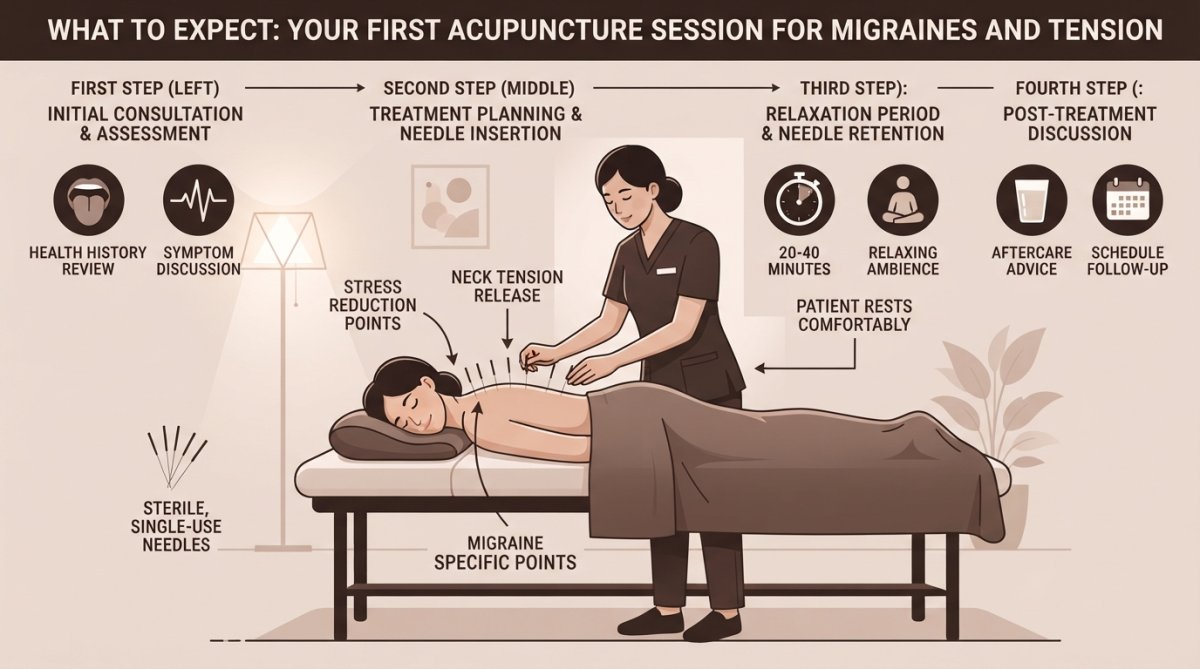
What to Expect: Your First Acupuncture Session for Migraines and Tension
Walking into an acupuncture clinic for the first time generates anxiety for many people. Understanding what actually occurs during treatment dissolves most of that anxiety.
The Assessment and Personalized Treatment Plan
Your first appointment includes a detailed 30-45 minute assessment. The practitioner will ask about your headache history: when they started, what triggers them, timing, what makes them worse or better, and how they impact your daily life. They’ll also ask about sleep quality, digestion, stress tolerance, and menstrual cycle timing (for women) to reveal hormonal triggers. Based on this comprehensive picture, your practitioner develops a customized treatment plan specifying which points will be needled and treatment frequency.
During and After Treatment: Sensations and Recovery
The needle insertion is quick and typically painless. Acupuncture needles are hair-thin, much finer than hypodermic needles. Once needles are in place, you lie still for 20-30 minutes while they work. Many patients fall into a deeply relaxed state. After removal, you’ll feel relaxed and often slightly drowsy as your parasympathetic nervous system activates.
It’s common to feel fatigued after your first few sessions as your body processes nervous system recalibration. This typically passes within a few hours. Stay hydrated, avoid strenuous activity, and rest if needed.
Cost, Insurance, and Finding a Qualified Practitioner
Licensing, Credentials, and What to Look For
Licensing requirements vary by state, but in California, licensed acupuncturists complete 3,000+ hours of training and pass rigorous board exams. The credential "Licensed Acupuncturist" or "L.Ac." indicates someone has met standardized competency requirements.
When evaluating a practitioner, ask about their experience treating migraines and tension headaches specifically. Do they customize treatment or use standardized protocols? Are they willing to coordinate with your doctor if you’re on medication? Source Acupuncture’s practitioners maintain current licenses and bring years of specialized experience treating headache disorders.
Insurance Coverage and Membership Options
Insurance coverage for acupuncture varies widely. Contact your insurance company to ask whether acupuncture for migraines is covered and what your out-of-pocket cost would be. Many patients find that even without insurance coverage, acupuncture becomes cost-effective compared to ongoing medication expenses and lost work productivity.
Source Acupuncture offers a flexible wellness membership program that makes consistent treatment accessible. Membership removes the barrier of per-session costs and encourages the regular treatment frequency that produces optimal results. Members prioritize booking and receive additional services like cupping or red light therapy as part of their membership benefits.
Be cautious of acupuncture clinics that pressure you into long-term prepaid packages. Legitimate practitioners offer flexible scheduling and allow you to adjust frequency based on your results. Monthly membership with no long-term commitment is the appropriate model.
Conclusion: Taking the Next Step Toward Migraine Relief
The gap between understanding acupuncture for migraines and tension intellectually and experiencing its effects personally is substantial. If you’ve tried medications that caused unacceptable side effects, or if preventative drugs simply don’t work for your specific migraine pattern, acupuncture deserves serious consideration. The evidence is strong, the safety profile is excellent, and long-term outcomes often exceed what medication alone achieves.
Source Acupuncture specializes in customized acupuncture treatment for migraines and tension-type headaches, integrated with broader wellness services including cupping, red light therapy, and stress management support. Our practitioners perform thorough assessments that identify your specific pattern, then develop treatment plans addressing root causes rather than masking symptoms. With our flexible wellness membership program, consistent treatment becomes sustainable and affordable.
The first step is simple: schedule a consultation with a qualified practitioner who can assess your specific situation and explain how acupuncture might work for you. Book Session with Source Acupuncture today and begin reclaiming your life from chronic migraines and tension.
According to the National Institutes of Health research on acupuncture efficacy, acupuncture demonstrates measurable effects on pain perception and nervous system function through mechanisms that modern neuroscience continues to validate. The American Headache Society clinical guidelines recognize acupuncture as a viable non-pharmacological option for migraine prevention when performed by qualified practitioners. Research from the Journal of Headache and Pain systematic review on acupuncture confirms that acupuncture produces sustained improvements in migraine frequency comparable to standard prophylactic medications, with significantly fewer adverse effects.
Frequently Asked Questions
Does acupuncture really help with migraines and tension headaches?
Yes, clinical evidence supports acupuncture as an effective non-pharmacological treatment for both migraine prophylaxis and chronic tension-type headaches. Multiple systematic reviews and clinical trials demonstrate that acupuncture reduces headache frequency, duration, and pain intensity. Many patients report sustained relief, particularly when combined with stress reduction and trigger management. However, individual results vary, some patients experience significant improvement, while others see modest benefits. A qualified practitioner can assess whether acupuncture is appropriate for your specific headache pattern.
How many acupuncture sessions are needed for migraine relief?
Most patients benefit from 8-12 initial sessions, typically scheduled once or twice weekly, followed by maintenance treatments every 2-4 weeks. However, the exact number depends on your headache frequency, severity, and how long you've had migraines. Some patients notice improvement within 3-4 sessions, while others require longer treatment courses. A licensed practitioner will develop a personalized plan based on your response and adjust frequency as needed. Consistency is key, regular sessions tend to produce better long-term outcomes than sporadic treatments.
What acupuncture points are used for headache and migraine relief?
Common acupuncture points for headache relief include LI-4 (Large Intestine 4) on the hand, GB-20 (Gallbladder 20) at the base of the skull, and GV-20 (Governing Vessel 20) at the crown. These points are chosen based on traditional meridian theory and neuromodulation principles. A qualified practitioner will select points tailored to your specific headache type, tension-type headaches may emphasize neck and shoulder points, while migraines may target points that reduce vascular inflammation. Trigger point acupuncture may also be used to release tight muscles contributing to pain.
Is acupuncture safer than migraine medication?
Acupuncture has a favorable safety profile with minimal side effects when performed by a licensed practitioner. Common minor effects include temporary soreness or bruising at needle sites. In contrast, prophylactic drug therapy carries potential side effects like dizziness, weight gain, or medication interactions. However, acupuncture is not necessarily a replacement for medication, many patients benefit from integration of both approaches. Discuss with your healthcare provider whether acupuncture alone is appropriate or whether combining it with medication offers better migraine control for your situation.
This article was written using GrandRanker