Last Updated: November 19, 2026
Quick Summary
Acupuncture for frozen shoulder can reduce pain enough to make physical therapy and home exercise tolerable, but it will not unfreeze the shoulder on its own. Evidence shows a modest, consistent drop in pain scores, with functional gains following when pain allows you to move.
- Frozen shoulder moves through freezing, painful, and stiffness stages before a slow recovery stage.
- A typical session includes assessment, point selection, needle placement, a movement check, and a home plan.
- Most trials are small with short follow-up, so reviews call for larger, better-controlled studies.
- A common schedule is once or twice a week for the first few weeks, then spacing out.
- Track pain on a 0-10 scale, overhead reach, and sleep quality week to week, not day to day.
Table of Contents
- How Acupuncture for Frozen Shoulder Pain Relief Works
- Acupuncture Points for Frozen Shoulder and What They Target
- A Typical Frozen Shoulder Acupuncture Protocol, Step by Step
- What the Evidence and Acupuncture for Frozen Shoulder Reviews Say
- Is Acupuncture the Best Treatment for Frozen Shoulder?
- Safety, Session Planning, and Tracking Your Progress
- Booking Your First Frozen Shoulder Session at Source Acupuncture
- Frequently Asked Questions
How Acupuncture for Frozen Shoulder Pain Relief Works
Frozen shoulder is one of the most stubborn joint problems a body can produce, and acupuncture for frozen shoulder pain relief has become a common complementary option for people who want to manage the pain without relying only on medication. This guide explains what the condition does to the joint, which acupuncture points are commonly used, what a session generally looks like, and how to judge whether it is working. The short answer: acupuncture will not unfreeze a shoulder on its own, but it can reduce pain enough that you can do the movement work that actually restores your range of motion.
What Frozen Shoulder Does to the Joint
Frozen shoulder, or adhesive capsulitis, is a condition where the connective tissue around the shoulder joint thickens and tightens (Frozen Shoulder – Adhesive Capsulitis – OrthoInfo). The joint capsule shrinks, leaving less room for the shoulder to move.
The result is a painful loss of motion. Reaching overhead, fastening a bra, or pulling on a jacket can become difficult. The condition usually moves through three stages: the freezing stage, the painful stage, and the stiffness stage, followed by a slow recovery stage. The rotator cuff itself is not the main problem, which is why some shoulder treatments miss the mark.
Symptoms That Point to Adhesive Capsulitis
The clearest sign is a shoulder that hurts and will not move far in any direction, especially outward rotation. Pain often worsens at night and disrupts sleep, which is a common reason people finally seek help.
Watch for these patterns:
- Deep, aching shoulder pain that builds over weeks
- Stiffness in all directions, not just one
- Pain that limits daily tasks like dressing or reaching a shelf
- Sleep disruption when lying on the affected side
If your pain came on after a fall or you have weakness rather than stiffness, get a medical evaluation first. Those signs point to other shoulder problems.

Acupuncture Points for Frozen Shoulder and What They Target
Acupuncturists select points around the shoulder and along the meridians that pass through it. The goal is to calm pain, ease muscle guarding, and improve circulation to the joint capsule so movement becomes less painful.
Common points in a frozen shoulder protocol may include:
- Points on the front and top of the shoulder, near the joint itself
- Points on the upper back and between the shoulder blade and spine
- A point on the outer upper arm that many people find tender
- Distal points on the forearm or lower leg that influence shoulder tension
The exact combination depends on your stage and symptoms. A painful, inflamed shoulder calls for a gentler approach than a stiff, quiet one. Needles are typically very fine, and most people feel little more than a brief pinch.
A Typical Frozen Shoulder Acupuncture Protocol, Step by Step
A practical protocol runs in phases rather than one fixed formula. In the painful stage, needling is often kept light with a focus on calming the nervous system. As pain settles, sessions shift toward restoring shoulder mobility and range of motion.
A typical structure for this kind of care looks like this:
- Assessment. Review your history, test your range of motion, and note which movements hurt most.
- Point selection. Choose local shoulder points plus a few distal points for pain reduction.
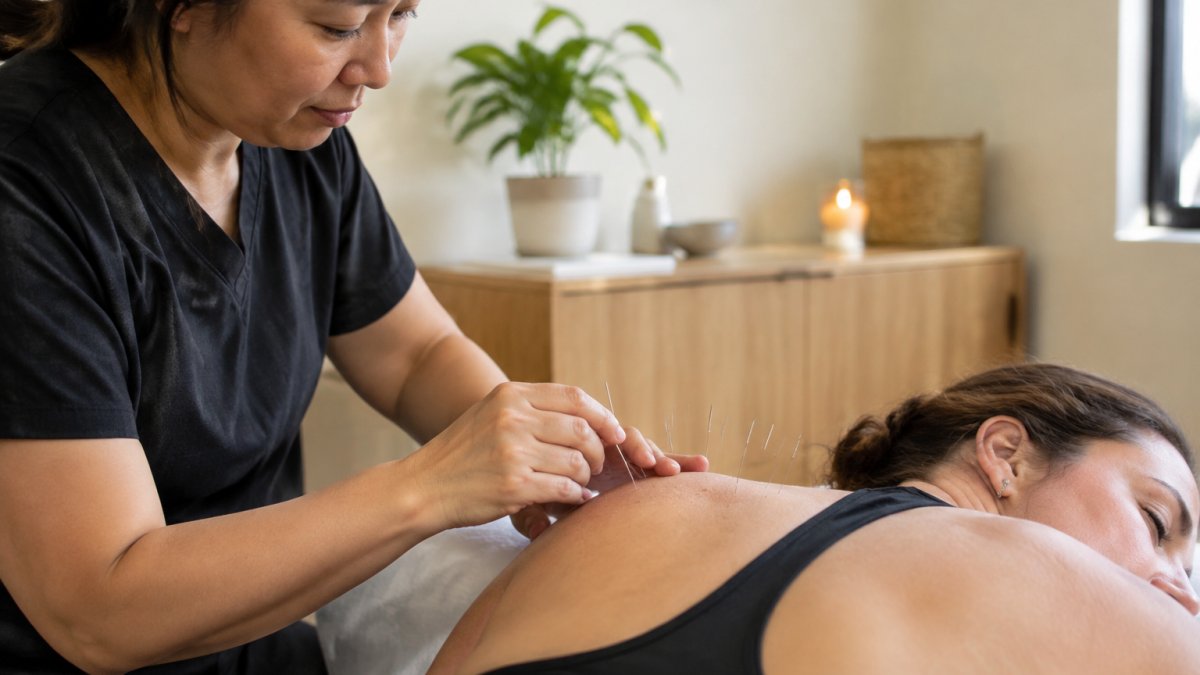
- Needle placement. Insert fine needles and leave them for a relaxed rest period.
- Movement check. Re-test your shoulder after the needles come out to see what changed.
- Home plan. Assign gentle exercises to keep the gains between visits.
Most people need a series of sessions rather than one. Treatment frequency is usually higher early on and spreads out as function improves.
Here is the step-by-step structure the article describes for a typical frozen shoulder acupuncture session.
| Step | What happens |
|---|---|
| Assessment | Review history, test range of motion, note painful movements |
| Point selection | Local shoulder points plus a few distal points |
| Needle placement | Fine needles left in for a relaxed rest period |
| Movement check | Re-test the shoulder after needles come out |
| Home plan | Gentle exercises to keep gains between visits |
What the Evidence and Acupuncture for Frozen Shoulder Reviews Say
The honest answer is that the evidence is mixed but encouraging, and the quality of that evidence matters as much as the direction of the results. Most clinical studies on acupuncture for frozen shoulder are small, and many compare acupuncture plus exercise or plus physical therapy against exercise or physical therapy alone rather than against a sham needle control. That design tells you whether adding acupuncture helps, but it does not fully isolate how much of the benefit comes from the needles themselves versus the extra attention, relaxation, and structured care that come with regular sessions.
A plain-language read of the literature looks like this:
- Pain intensity. The most consistent finding across reviews is a modest reduction in pain scores, often described as a meaningful but not dramatic drop on a 0-10 scale. Few studies report complete pain elimination.
- Shoulder function and range of motion. Functional scores and range-of-motion measures tend to improve when acupuncture is combined with exercise, but the added benefit over exercise alone is smaller and less consistent than the pain findings.
- Study quality. Many trials have small sample sizes, short follow-up, and inconsistent needling protocols, which makes it hard to pool results with confidence. Blinding is difficult because patients can usually tell whether they received needles.
- Uncertainty. Reviews generally call for larger, better-controlled trials before firm conclusions can be drawn about optimal point selection, session frequency, or which stage of frozen shoulder responds best. (Source: clinical guidelines from the American Academy of Orthopaedic Surgeons)
What this means for you in practical terms:
- Acupuncture is best treated as a complementary treatment, not a replacement for movement work. The pain relief it offers is most useful when it makes physical therapy and home exercise tolerable.
- Pain reduction is the most consistent reported benefit, and functional improvement tends to follow when pain drops enough to allow exercise.
- Results vary widely from person to person, and a modest average effect does not tell you whether you will be a strong responder or a weak one. The only reliable test is a time-limited trial with clear before-and-after measures.
- Because the evidence is not definitive, a fair trial means giving it a defined window, tracking pain and range of motion, and reassessing rather than continuing indefinitely on hope alone.
For broader context on how acupuncture fits into chronic pain care, see our guide to acupuncture for chronic pain relief.
Is Acupuncture the Best Treatment for Frozen Shoulder?
There is no single best treatment for frozen shoulder. The strongest approach generally combines physical therapy and exercise with pain control, and acupuncture can be a useful part of that plan for some people. It does not replace stretching and strengthening, which remain the core of recovery.
Where acupuncture helps most is in breaking the pain cycle. When a shoulder hurts, people guard it, and guarding makes stiffness worse. Calming the pain can make exercise tolerable again.
How does it compare with massage? Massage targets muscle tension, while acupuncture works on pain signaling and the nervous system. Our comparison of acupuncture vs massage for pain breaks down the differences. For a deeper look at how acupuncture addresses shoulder pain specifically, read our article on acupuncture for chronic neck and shoulder pain.
Safety, Session Planning, and Tracking Your Progress
Acupuncture is generally considered low-risk when performed by a licensed practitioner using sterile, single-use needles. Because safe needling depends on proper training and sterile technique, choosing professional acupuncture services is an important part of managing treatment risks.
Choosing a qualified practitioner. Look for a licensed acupuncturist in your state, and ask whether the practice uses sterile, single-use needles and follows clean-needle technique.
Cost. Pricing depends on the practitioner, the number of sessions, and any package or membership terms, so ask for current pricing directly from the clinic or check its website.
Tracking your progress between sessions. Simple measures beat vague impressions:
- Note pain intensity on a 0-10 scale before and after each session
- Record how far you can reach overhead and behind your back
- Log sleep quality, since better sleep is an early sign of improvement
- Compare week to week, not day to day
Watch out: skipping sessions early in the painful stage often slows progress, because the pain relief that makes exercise possible fades before the habit sticks.
If you want a realistic sense of timelines, our article on how long acupuncture takes to work for back pain explains the pacing we typically see.
Booking Your First Frozen Shoulder Session at Source Acupuncture
You do not need a referral to start. At Source Acupuncture, care is personalized to your needs. Our licensed practitioners offer care for pain, stress, and recovery, blending traditional healing practices with advanced therapeutic techniques.
What to expect on your first visit:
- A conversation about your history and daily limitations
- A range-of-motion check
- Your first treatment, tailored to your pain level
- A simple home plan you can actually follow
A wellness membership program is available for people who want consistent sessions. You can review our services and location details on our acupuncture in Pacific Beach page before you book.
Frozen shoulder rewards patience and consistency, and the right support makes the slow weeks easier to get through. If pain is keeping you from the movement work that restores your shoulder, we can help you build a plan that fits your stage and schedule. Source Acupuncture offers personalized assessments, licensed practitioners, and a membership program designed for steady care.
Frequently Asked Questions
Does acupuncture really work for frozen shoulder?
Clinical studies and reviews generally report that acupuncture for frozen shoulder can reduce pain intensity and improve range of motion, especially when combined with physical therapy and exercise. Results vary by person and by stage of the condition. Acupuncture is best treated as a complementary option alongside standard care rather than a guaranteed stand-alone cure, so plan on tracking your own shoulder movement between sessions to judge progress.
How many acupuncture sessions might frozen shoulder require?
Most frozen shoulder acupuncture protocols use a course of sessions rather than a single visit, often starting once or twice weekly and tapering as symptoms settle. The freezing and stiffness stages typically need more frequent care than the recovery stage. Your practitioner should reassess range of motion and pain every few sessions and adjust the schedule, so ask upfront how progress will be measured before you commit to a membership.
What acupuncture points are used for frozen shoulder?
Points are usually chosen around the affected shoulder and upper back, along the neck, and on the opposite arm or leg to address the whole meridian pattern. Common areas include the top of the shoulder, the front and back of the shoulder joint, and points between the shoulder blade and spine. A frozen shoulder acupuncture protocol is tailored to your stage and symptoms, so the exact combination changes between visits.
Can acupuncture and physical therapy be used together?
Yes, and many practitioners recommend it. Acupuncture may help lower pain enough that you can do prescribed stretching and strengthening exercises more comfortably. Tell both your physical therapist and your acupuncturist what the other is doing, and schedule sessions so they support rather than crowd each other. If pain worsens sharply after exercise, or you notice new weakness or numbness, get a medical evaluation before continuing.