Last Updated: November 14, 2026
Quick Summary
The best minimalist shoes for beginners balance a wide, foot-shaped toe box with enough underfoot protection to ease the transition from cushioned footwear. Pick a beginner-friendly pair and increase wear time slowly, starting with 20-30 minutes a day in weeks 1-2.
- The Lems Primal Zen is the safest starting point for most beginners, pairing a wide toe box with a flexible sole.
- WHITIN Shoes are the budget pick, with styles reported in the $40-$50 range.
- Add roughly a thumb’s width, about half an inch, between your longest toe and the front of the shoe.
- Weeks 3-4 extend to 45-60 minutes of flat pavement walking, three to four days a week.
- Stop and see a clinician if you develop sharp pain, swelling, or pain lasting beyond a day or two.
Table of Contents
- Quick Comparison: Best Minimalist Shoes for Beginners
- How We Evaluated These Beginner Minimalist Shoes
- 1. Lems Primal Zen: Best Overall for Everyday Wear
- 2. Xero Shoes Prio: Best for Casual Wear and Gym Training
- 3. WHITIN Shoes: Best Budget Pick Under $50
- 4. Merrell Vapor Glove 6: Best Barefoot Shoes for Walking
- 5. Xero Shoes HFS II: Best Barefoot Shoes for Running
- 6. AIRHAS Knit Barefoot Shoe: Best Barefoot Shoes for Everyday Use
- How to Choose Based on Foot Shape and Fit
- Your Staged Transition Plan: Weeks 1 to 12
- Frequently Asked Questions
Quick Comparison: Best Minimalist Shoes for Beginners
The best minimalist shoes for beginners balance a wide, foot-shaped toe box with enough underfoot protection to ease the transition from cushioned footwear. People who adapt well to minimalist footwear tend to pick a beginner-friendly pair and increase wear time slowly. Below, we break down seven options, then walk through a staged transition plan to build foot strength without overloading your feet. (Source: National Institutes of Health)
| Shoe | Best For | Reported Price | Key Feature |
|---|---|---|---|
| Lems Primal Zen | Everyday wear | Not listed | Versatile, beginner-friendly design |
| Xero Shoes Prio | Casual wear and gym | Not listed | One shoe for training and daily use |
| WHITIN Shoes | Budget pick | $40-$50 | Low-cost entry point |
| Merrell Vapor Glove 6 | Walking | $90 | Committed minimalism |
| Xero Shoes HFS II | Running | Not listed | Strong minimalist running pick |
| AIRHAS Knit Barefoot Shoe | Everyday use | Not listed | Knit upper, beginner-focused |
How We Evaluated These Beginner Minimalist Shoes
Beginners should judge a minimalist shoe by a few things they can feel directly: toe box width, sole flexibility, stack height, and how forgiving the shoe is during the first weeks of wear. A transition shoe should let your toes splay and your foot move naturally without punishing you on hard pavement. We also weighed price and versatility, since most beginners want one pair for walking, errands, and light training. Before you buy, read our guide on how to transition to barefoot running safely.
1. Lems Primal Zen: Best Overall for Everyday Wear
For most beginners, the Lems Primal Zen is the safest starting point. It pairs a wide, anatomical toe box with a flexible sole and a shape that looks like a normal casual shoe, so it is easy to wear daily. That versatility matters more than any single spec early on: the more consistently you wear a pair, the faster your feet adapt. It is not the most minimal option here, so runners chasing pure ground feel may want something thinner.
2. Xero Shoes Prio: Best for Casual Wear and Gym Training
The Xero Shoes Prio earns its spot by doing two jobs well: casual wear and gym training, which suits beginners who want one pair for errands and workouts. A common mistake is treating a gym-capable shoe as a running shoe; if running is your focus, look at a dedicated model below.
3. WHITIN Shoes: Best Budget Pick Under $50
If cost is your main concern, WHITIN is the obvious entry point. Styles are reported in the $40-$50 range, making it one of the most affordable ways to try a minimalist shoe without a big commitment. The catch: the lineup is broad, and the supplied reviews do not pin the price range to a specific model, so check the exact listing. For a first pair you are not sure about, that low price lowers the risk.
4. Merrell Vapor Glove 6: Best Barefoot Shoes for Walking
If walking surfaces aggravate your shins, our guide to treating runner shin splints naturally covers prevention and recovery.
5. Xero Shoes HFS II: Best Barefoot Shoes for Running
The drawback: running loads the foot far more than walking, so do not jump straight into your normal mileage. Our articles on how sleep quality impacts athletic performance and recovery therapies for athletes both help you support adaptation off the road.
6. AIRHAS Knit Barefoot Shoe: Best Barefoot Shoes for Everyday Use
If everyday wear brings on foot discomfort, our guide to managing chronic nerve pain in the foot naturally offers non-surgical approaches to discuss with a clinician.
How to Choose Based on Foot Shape and Fit
Fit decides whether a minimalist shoe helps or hurts you, and it matters more here than in conventional footwear because there is less foam and structure to mask a poor match. Most guides stop at “size up and look for a wide toe box.” The method below is more specific: measure your foot, then match length, width, and volume to the shoe’s last.
Measure length and width at the end of the day. Feet swell over the course of the day, so measure in the late afternoon or evening. Stand on paper with your heel against a wall, trace the outline, and measure from the heel line to the tip of your longest toe. Measure both feet and use the longer one. For width, measure across the widest part of the ball of your foot.
Add toe allowance, then compare to the size chart. In a minimalist shoe you want roughly a thumb’s width, about half an inch, between your longest toe and the front of the shoe, so add that to your measured length before checking the brand’s chart. Do not assume your usual running-shoe size carries over; last shapes differ between brands.
Check toe-box shape, not just toe-box width. A wide toe box that tapers to a point still crowds your toes. Look for a shoe whose widest point sits at the ball of your foot and whose outline stays broad toward the toes, so the big toe can point forward rather than angle inward.
Account for volume. Volume is the height of the shoe over the top of your foot, and it is the dimension beginners overlook. A high-volume foot can feel pinched across the top even in a wide shoe, while a low-volume foot can swim and slide forward, jamming the toes. Adjust with lacing first: a runner’s loop at the top eyelet can lock the heel in a low-volume foot, and looser midfoot lacing relieves pressure on a high instep.
Test heel hold and midfoot security. A correctly fitting minimalist shoe feels roomy up front and snug through the midfoot, with no heel slip. Walk a few steps and check that your heel stays seated and your foot does not slide forward when you stop. With little cushioning to absorb movement, a loose heel is more noticeable on pavement than in a cushioned shoe.
Match the shoe to your foot shape and use. A broad forefoot with a narrow heel does best with a wide toe box and a secure heel counter. A high instep needs adjustable lacing rather than a slip-on knit collar. A very wide foot may need brands that publish last width in inches rather than relying on “wide” labels.
Try before you commit when you can. Order from a retailer with a return policy that allows outdoor wear, and test the shoe on a short walk rather than only around the house. Fit problems tend to show up as toe pressure or heel slip within the first mile, not on the carpet. If you cannot try in person, order two sizes when the policy allows and return the one that does not fit.
Your Staged Transition Plan: Weeks 1 to 12
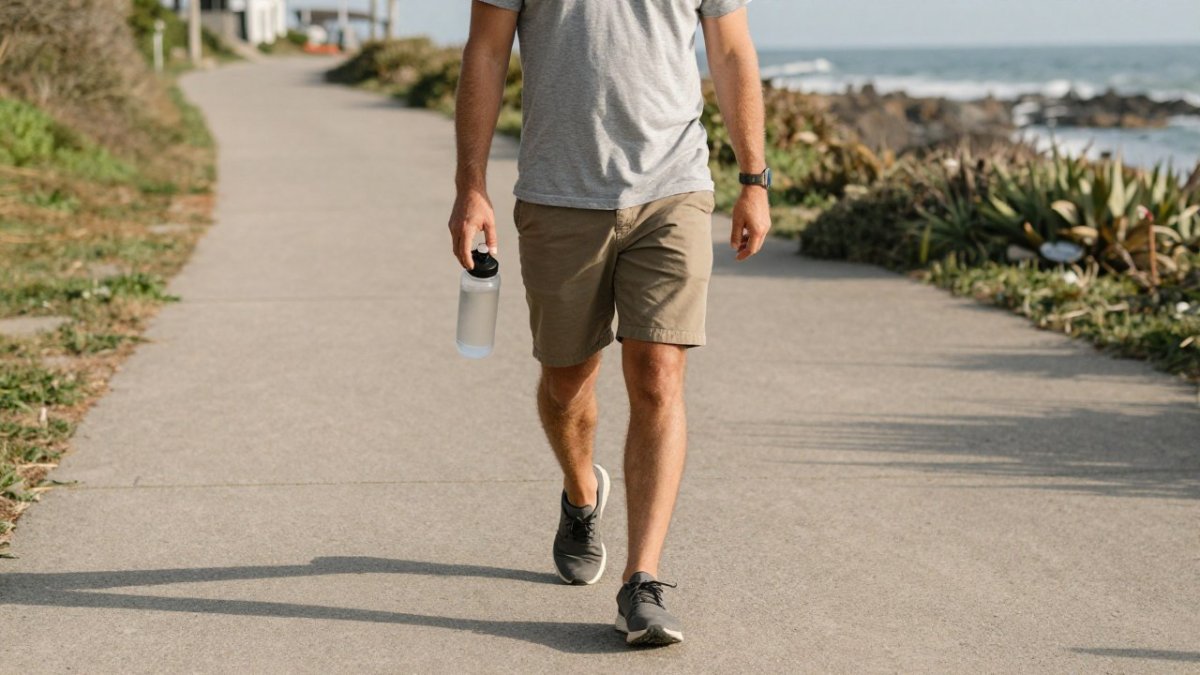
A staged plan is the difference between building foot strength and waking up sore. Add load in small increments, and let next-day comfort, not the clock, decide when to move to the next stage. The schedule below is a template, not a prescription. If you are older, heavier, or coming off an injury, stretch each stage and start at the low end of every range.
Weeks 1-2: Short, frequent exposure. Wear your minimalist shoes for 20-30 minutes a day, indoors or on soft ground such as grass or a rubber track. The goal is not distance; it is letting your feet feel the ground and your calves and arches begin to load differently. Keep conventional shoes for everything else, including your commute and long errands. Two short sessions a day beat one long one.
Weeks 3-4: Flat pavement walking. Extend to 45-60 minutes of walking on flat pavement, three to four days a week, with a rest day between sessions. This is where most beginners first feel calf tightness, because a lower heel drop shifts load to the Achilles and calf. Keep the pace easy enough to hold a conversation. If you feel a dull ache during the walk, shorten the next session rather than pushing through.
Weeks 5-8: Varied terrain and light gym work. Add light gym work, bodyweight squats, lunges, step-ups, and balance drills, in minimalist shoes two days a week, and introduce short walks on varied terrain such as packed dirt or a gentle trail. Uneven ground asks your foot to move in more directions but also loads the ankle, so keep these walks to 30-45 minutes at first. Continue alternating minimalist days with conventional-shoe days if your calves still feel tight the morning after.
Weeks 9-12: Introduce short runs. If walking is comfortable with no next-day soreness, add short runs of 5-10 minutes at an easy pace, two to three times a week, alternating with rest or walking days. Do not convert your entire weekly mileage at once; a common approach is to run the first few minutes of a familiar route in minimalist shoes and switch back to your usual shoes for the remainder, lengthening the minimalist segment over several weeks. Keep total weekly running time modest through week 12.
What normal adjustment feels like. Most beginners notice mild calf and arch soreness in the first two to three weeks, especially after the first pavement walks. That soreness should ease with rest and should not change how you walk the next day. A common pattern is soreness that appears the evening after a session and is gone by the following morning.
When to stop and reassess. Watch out: sharp pain, swelling, pain that persists beyond a day or two, or pain that changes your gait are not normal adjustment signs, stop the minimalist sessions and have a qualified clinician evaluate you before continuing. Do not use a fixed calendar to override those signals; repeating a stage for an extra two weeks costs you nothing.
The mistakes that derail beginners. The most common is doubling wear time too fast because the shoes feel comfortable in the moment; comfort during a session is not the same as tolerance the next day. The second is wearing minimalist shoes for a long standing shift or a full day of errands before the feet have adapted. The third is adding running mileage and gym volume in the same week.
Frequently Asked Questions
What should I look for in my first pair of minimalist shoes?
Prioritize a zero-drop sole, a wide anatomical toe box, and a thin, flexible sole that lets your foot move naturally. Check the stack height, since thinner soles generally give more ground feel than thicker ones. Make sure you can wiggle your toes freely and that the shoe bends easily at the ball of the foot. A removable insole helps you adjust ground feel as your feet adapt.
How should beginners transition to minimalist shoes?
Start with short sessions and increase time gradually each week. Keep your conventional shoes for long days or high-impact activity while your feet and calves adapt. Expect mild soreness in the calves and arches for the first few weeks. If pain persists beyond a day or two, back off and reduce your time in minimalist shoes.
Are minimalist shoes comfortable on concrete?
They can be, but concrete is unforgiving because it offers no give. Choose a model with a slightly thicker sole and reliable outsole grip, and build up your walking time gradually. Many beginners alternate between minimalist shoes and cushioned shoes on hard surfaces until their feet and calves adapt.
Can beginners run in minimalist shoes?
Yes, but only after a walking base. Spend four to six weeks walking in minimalist shoes before adding short run intervals of one to two minutes. Stop and reassess if you feel sharp heel or arch pain, and consider pairing the transition with recovery care for tight calves and sore feet.