Last Updated: November 12, 2026
Quick Summary
Contrast water therapy alternates warm and cold water to ease muscle soreness, mainly by lowering how sore you feel in the short term. Research suggests a modest, short-lived effect on perceived soreness, but it does not clearly speed healing or improve performance.
- A common routine alternates about 3 to 4 minutes of warm water with about 1 minute of cold water.
- Repeat the cycle for roughly 15 to 20 minutes total, typically 3 to 5 rounds.
- Studies report modest, short-lived reductions in self-rated soreness, not faster tissue healing.
- There is no good evidence that contrast therapy prevents injuries or improves long-term strength.
- Avoid it or get medical advice if you have heart disease, diabetes with reduced sensation, Raynaud’s, or are pregnant.
Table of Contents
- What Contrast Water Therapy Is and How Alternating Temperatures Work
- Benefits of Contrast Water Therapy for Soreness
- What the Research Shows and What It Does Not
- Contrast Therapy Timing: When to Use It After Exercise
- Contrast Therapy at Home: A Step-by-Step Protocol
- Disadvantages of Contrast Therapy and Who Should Avoid It
- Booking a Recovery Consultation at Source Acupuncture
- Frequently Asked Questions
What Contrast Water Therapy Is and How Alternating Temperatures Work
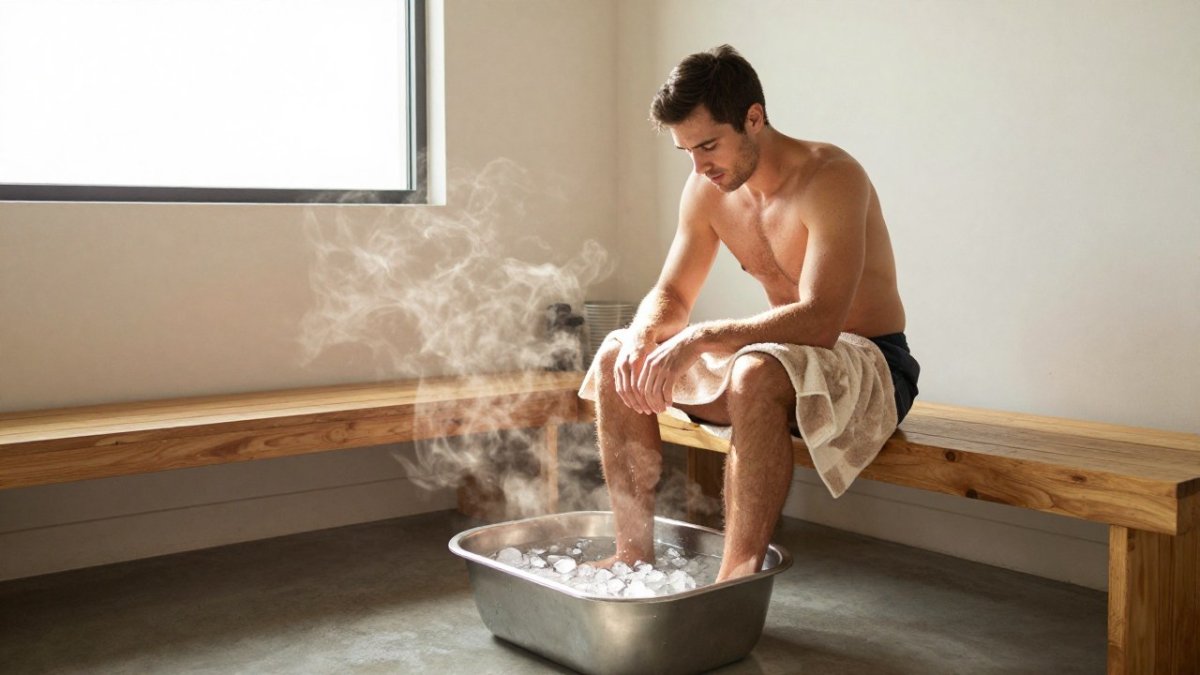
Contrast water therapy is the practice of alternating between warm water and cold water, usually in short cycles, to help the body recover after hard training. Many people use it in a home tub or shower. (Source: National Institutes of Health)
The idea is simple. Warm water tends to widen blood vessels, and cold water tends to narrow them. Moving between the two temperatures is thought to change blood flow in the muscles, though researchers are still working out how much this matters in practice.
Here is the typical pattern many people follow:
- Warm water: about 3 to 4 minutes
- Cold water: about 1 minute
- Repeat the cycle for roughly 15 to 20 minutes total, always ending on cold or warm as your protocol specifies
Keep the water comfortable, not painful. If the cold feels unsafe or the heat feels too strong, shorten the time or raise or lower the temperature.
Benefits of Contrast Water Therapy for Soreness
Most people use contrast therapy to ease soreness after a hard workout or a long day on their feet. The benefits people report tend to fall into a few groups, and the evidence behind each one varies.
Effects on Delayed-Onset Muscle Soreness and Pain Perception
Delayed-onset muscle soreness, or DOMS, usually peaks one to three days after unfamiliar or intense exercise. Many athletes use contrast therapy in the hours and days that follow, hoping to take the edge off that ache.
Some studies suggest that contrast therapy may lower the perceived intensity of soreness. Researchers often measure this with a visual analog scale, a simple line on which people rate their pain. Results are mixed, and many of the trials are small, so treat any pain relief as a possible benefit rather than a guarantee.
Swelling, Mobility, and Recovery After Exercise
Some people also use contrast therapy to manage swelling and to help joints move more freely after training. The alternating temperatures may influence fluid movement in the tissue, which could make the limb feel less puffy and stiff.
Recovery is also about getting back to normal function. Many users say their muscles feel looser and their range of motion improves, which can make the next session feel more comfortable.
What the Research Shows and What It Does Not
Most reviews of contrast water therapy reach a similar cautious conclusion: it may take the edge off how sore you feel in the short term, but the evidence is not strong enough to promise faster healing, better performance, or injury prevention. The useful move is to separate what the research actually supports from what people assume it supports.
What the evidence supports
- Short-term perceived soreness. Several small trials and reviews report lower self-rated soreness or pain in the hours and first day or two after exercise when people use contrast baths, compared with doing nothing. The effect is usually described as modest and short-lived.
- Perceived recovery and fatigue. Some studies find that people feel more recovered and less fatigued after contrast therapy, again based on self-report rather than lab measures of muscle damage.
- Comfort and mobility in the moment. Users often report that a limb feels looser and moves more freely right after a session, which can make the next training day feel more manageable.
What the evidence does not support
- Faster tissue healing. There is no consistent evidence that alternating temperatures speeds repair of muscle fibers or resolves injury. Feeling better is not the same as healing faster.
- Long-term strength or performance gains. Reviews generally do not find that contrast therapy improves strength, power, or sport performance over time.
- Injury prevention. No good evidence shows that contrast baths prevent injuries.
- A clear dose-response. Researchers have not settled on the best temperatures, cycle lengths, or total session time, so ‘more’ is not established as ‘better.’
Why the research is hard to read
Most studies are small, often involving a few dozen healthy adults rather than people with real injuries. Many rely on self-reported pain scales, which are subjective and hard to blind, participants usually know whether they are in cold water or warm water. Protocols vary widely across studies, from a few minutes to 20-plus minutes and from cool tap water to near-ice baths, so results do not stack up cleanly.
A fair summary is that contrast therapy is a low-cost comfort tool with plausible short-term benefits for how soreness feels, but it is not a proven treatment for muscle damage, and it should not replace sleep, nutrition, graded loading, and rest.
Contrast Therapy Timing: When to Use It After Exercise
Timing matters. Many people use contrast therapy within a few hours after a hard session, when they first start to feel sore. Others wait until the next day, when DOMS is at its peak.
A practical approach looks like this:
- Use it within the first few hours if you want to ease early stiffness.
- Use it the next day or two if soreness is the main problem.
- Skip it right after heavy strength work if you want to preserve the muscle-building response, since some research suggests cold water can blunt it.
Watch out: if your soreness is sharp, one-sided, or comes with swelling and bruising, stop self-treating and get it checked. (Source: systematic review of recovery interventions)
Contrast Therapy at Home: A Step-by-Step Protocol
You do not need special equipment to try contrast therapy at home. Two basins, or a tub plus a shower, are enough. The goal is a repeatable sequence you can adjust, not a rigid prescription, start conservative and build only if it feels comfortable.
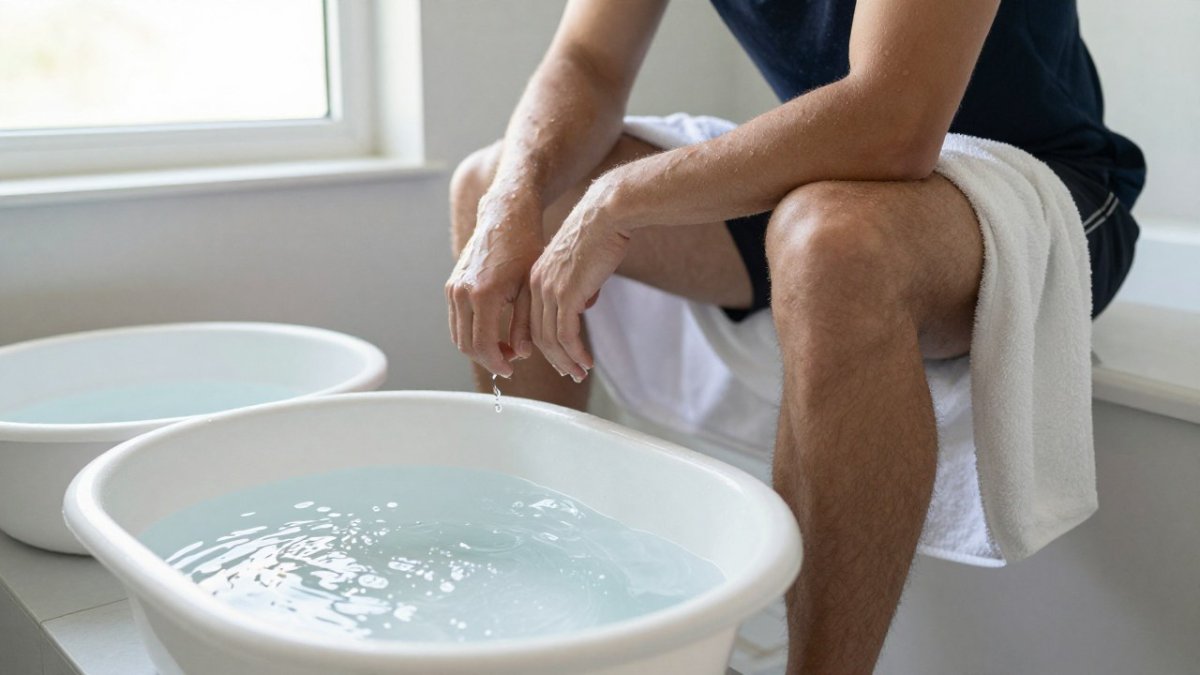
A conservative starting protocol for soreness
- Set the temperatures. Fill one basin with warm water around 100 to 104 degrees Fahrenheit and another with cool water around 50 to 60 degrees Fahrenheit. Use a thermometer if you have one; if not, test with your hand and err on the side of less extreme.
- Start with warm. Submerge the sore area in the warm water for 3 to 4 minutes. This is the standard starting point in most published protocols.
- Switch to cool. Move the same area into the cool water for about 1 minute. Keep it brief on the first session.
- Repeat 3 to 5 cycles. A common pattern is 3 to 5 warm-cold rounds, for a total of roughly 15 to 20 minutes including transitions.
- End on cool. Most protocols finish with the cold phase, which many people find leaves the limb feeling refreshed rather than overheated.
- Dry off and move gently. Pat the area dry, put on loose clothing, and take a few minutes of easy movement or rest before returning to activity.
A first-session adjustment
If you have never tried contrast therapy, shorten the first session: use 2 to 3 cycles, keep the cold phase to 30 to 45 seconds, and keep the warm water at the lower end of the range. Increase toward the full protocol over several sessions only if you feel comfortable and steady afterward.
Why the order and ending temperature matter
Starting with warm water lets the tissue warm gradually before the cold shock, which many people find more tolerable. Ending on cool is common because it leaves the area feeling less congested, though some protocols end on warm for comfort. Pick one pattern and keep it consistent so you can judge whether it helps.
Watch out: never use water hot enough to scald, and never combine contrast therapy with alcohol, sedatives, or exhaustion, since those raise the risk of dizziness or falls in or near a tub.
Practical setup and hygiene
- Keep a towel and a stable chair or non-slip mat next to each basin.
- Clean and dry basins between uses, especially if you have any skin breaks.
- Keep the room warm so you are not chilled between cycles.
- Stop the session if you feel lightheaded, short of breath, or unusually cold, and sit down until it passes.
When to skip the home protocol
Do not run this protocol on an area with an open wound, rash, or infection, and do not use it as a substitute for assessment if soreness is sharp, one-sided, or accompanied by swelling, bruising, or loss of function. If you have a cardiovascular condition, diabetes with reduced sensation, or Raynaud’s phenomenon, get clinical guidance before starting temperature contrast at home.
The table below summarises the conservative home protocol described in this section.
| Step | What to do | Time or frequency |
|---|---|---|
| Set temperatures | Warm water around 100-104°F; cool water around 50-60°F | Before starting |
| Start with warm | Submerge the sore area in warm water | 3-4 minutes |
| Switch to cool | Move the same area into cool water | About 1 minute |
| Repeat cycles | Alternate warm and cool rounds | 3-5 cycles, roughly 15-20 minutes total |
| End on cool | Finish the final phase in cool water | Last cycle |
| Dry off and move gently | Pat dry, wear loose clothing, move easily | A few minutes after |
Disadvantages of Contrast Therapy and Who Should Avoid It
Contrast therapy is not right for everyone. The temperature swings can be uncomfortable, and some people feel dizzy or lightheaded after a session.
Avoid contrast therapy, or check with a doctor first, if you:
- Have heart disease, high or low blood pressure, or circulation problems
- Have diabetes or nerve damage that reduces sensation in your feet or hands
- Have an open wound, a skin infection, or a rash on the treated area
- Are pregnant
- Have Raynaud’s phenomenon or are sensitive to cold
Contrast therapy also does not replace medical care for a serious injury. Do not rely on it for a suspected sprain, fracture, or pain that keeps getting worse.
Booking a Recovery Consultation at Source Acupuncture
If you want a hands-on approach to recovery, our team at Source Acupuncture can talk through your options. Our licensed practitioners can talk through your symptoms and goals.
We offer a range of recovery services, including book a red light therapy session in Pacific Beach for heat-and-light support after training. You can also learn about cupping as a sports recovery method if you want another hands-on option to compare.
To get started, reach out to Source Acupuncture for a consultation. Our team can help you choose a plan that supports your recovery and the way you train.
Frequently Asked Questions
Why do I feel so good after contrast therapy?
Alternating warm and cool water causes blood vessels to widen and narrow repeatedly, which many people describe as a pumping or flushing sensation. Warmth tends to ease muscle tension and make movement feel looser, while cooling can reduce the sense of soreness for a short time. These effects are typically temporary and vary from person to person. Research on contrast water therapy for soreness is mixed, so the feeling of relief is best treated as a subjective, short-term response rather than proof of lasting repair.
How long should I stay in contrast baths?
Many home routines use a warm phase of about three to four minutes followed by a cool phase of about one minute, repeated for roughly 15 to 20 minutes total and ending on cold. Study protocols vary widely in temperatures and durations, so there is no single validated timing. Start with shorter sessions, keep the water temperatures comfortable rather than extreme, and stop if you feel numbness, dizziness, or discomfort. Ask a qualified professional if you have a health condition before setting your own schedule.
Is contrast water therapy safe for everyone?
Contrast water therapy is generally low risk for healthy adults, but it is not appropriate for everyone. People with cardiovascular disease, circulation problems, Raynaud’s phenomenon, diabetes with nerve or skin sensation changes, open wounds, or who are pregnant should speak with a qualified healthcare provider first. Temperature swings can strain the cardiovascular system and affect sensation. Individual guidance from a licensed professional is the safest starting point.