Table of Contents
- What PCOS Is and Why Symptoms Vary So Much
- How Acupuncture for PCOS Symptom Management Works
- Acupuncture for Irregular Periods and Cycle Regulation
- Acupuncture for PCOS Fertility and Ovulation
- PCOS Acupuncture Research: What the Evidence Actually Shows
- Stress, Headaches, and Other Symptoms Beyond Fertility
- PCOS Diet and Lifestyle: Where Acupuncture Fits
- Safety, Session Planning, and What to Expect
- Frequently Asked Questions
Last Updated: October 21, 2026
What PCOS Is and Why Symptoms Vary So Much
Polycystic ovary syndrome (PCOS) is a hormonal and metabolic condition in which the ovaries produce higher-than-typical levels of androgens, ovulation becomes irregular, and periods may stop altogether ([Eunice Kennedy Shriver National Institute of Child Health and Human Development](https://www.nichd.nih.gov/health/topics/factsheets/pcos)). At Source Acupuncture, we see the same pattern repeatedly: two patients with the same diagnosis walk in with completely different complaints.
One has irregular periods and acne. Another has fertility concerns and thinning hair. A third has none of those but struggles with anxiety and headaches.
That variability is not a diagnostic failure. PCOS is a syndrome, meaning it is defined by a cluster of features rather than a single cause, and the diagnostic criteria used by the National Institutes of Health allow clinicians to reach the same label through several different routes. Insulin resistance, androgen levels, body weight, genetics, and stress load all shift how the condition presents.
This matters for anyone considering acupuncture for PCOS symptom management. There is no single protocol that treats “PCOS.” There are protocols that target the symptom in front of you.
How Acupuncture for PCOS Symptom Management Works
Acupuncture for PCOS symptom management is the use of fine, sterile needles at specific body points to influence the nervous system, blood flow, and hormonal signaling, with the goal of reducing individual symptoms rather than curing the syndrome. The mechanism is best understood as regulatory rather than corrective.
Traditional Chinese medicine describes the effect as moving qi and blood and resolving stagnation. Modern research frames it differently: needling appears to modulate the hypothalamic-pituitary-ovarian axis, the feedback loop that governs ovulation and menstrual cycling.
A common mistake is expecting acupuncture to act like a drug with a fixed dose and a predictable outcome. It behaves more like physical therapy for a dysregulated system. Progress comes from repetition, and the response varies by person.
Acupuncture for Irregular Periods and Cycle Regulation
Cycle regulation is the outcome most consistently reported by patients, and it is the one worth measuring first. Many people seeking acupuncture for irregular periods are not trying to achieve pregnancy; they want predictability.
In practice, we track cycle length, flow, and symptom timing across three to six months. That record does more than any single session to show whether treatment is working.
- Baseline: log the last three cycles before your first visit
- During treatment: note the start date, duration, and any spotting
- Review point: compare at the eight-to-twelve-week mark
Some patients see shorter cycles and more regular ovulation within a few months. Others see flow and cramping improve before timing normalizes. Both count as progress.
Acupuncture for PCOS Fertility and Ovulation
Fertility is where the research is most active and where expectations need the most care. Acupuncture for PCOS fertility support is typically used alongside medical care, not as a replacement for it.
The honest position: evidence suggests acupuncture may support ovulation and improve outcomes when combined with standard fertility treatment, but the studies are small and results are mixed. We never tell a patient acupuncture will get them pregnant.
What we can say is that reducing stress, improving sleep, and regulating the cycle create better conditions for conception and for tolerating fertility treatment. If you are working with a reproductive endocrinologist, tell your acupuncturist the protocol and timing so sessions can be scheduled around it.
Do not stop prescribed ovulation medication or skip monitored cycles to pursue acupuncture alone. For anyone actively trying to conceive, acupuncture is an adjunct, and abandoning medical management can cost you time you cannot recover.
PCOS Acupuncture Research: What the Evidence Actually Shows
PCOS acupuncture research is promising but not settled, and the most useful thing a guide can do is separate what the evidence supports from what it does not. The literature includes systematic reviews and randomized trials examining menstrual frequency, hormone levels including luteinizing hormone (LH), follicle-stimulating hormone (FSH), and testosterone, plus ovulation and live-birth rates.
The central contradiction is this: several reviews report improvements in cycle regularity and some hormonal markers compared with control groups, while other analyses conclude that acupuncture did not improve fertility outcomes, including live birth. Both findings can be true at once because they measure different things. A change in menstrual frequency is a symptom outcome. A live birth is a fertility outcome.
A second layer of uncertainty comes from study design. The recurring limitations are consistent across reviews: small sample sizes, short follow-up, inconsistent point selection, difficulty blinding participants, and wide confidence intervals in pooled analyses. Wide intervals mean the true effect could range from meaningful to negligible. That is not a reason to dismiss the research; it is a reason to read it as provisional rather than definitive.
What most guides miss is that “acupuncture works for PCOS” is the wrong question. The useful question is which symptom, at what intensity, over what duration, compared with what alternative. The table below organizes the evidence that way, with plain-language grades rather than false precision.
| Symptom or outcome | What the evidence suggests | Confidence | What to track |
|---|---|---|---|
| Irregular periods | Some reviews report improved cycle regularity versus control | Low to moderate, mixed | Cycle length, flow, spotting |
| Ovulation | Possible improvement, often alongside standard care | Low, emerging | Confirmed ovulation, cycle logs |
| Fertility and live birth | Findings conflict; some analyses show no improvement | Low, conflicting | Treatment tolerance, not promises |
| Hormonal balance (LH, FSH, testosterone) | Mixed results across small trials | Low, mixed | Labs ordered by your physician |
| Stress and anxiety | Reasonable support for relaxation response | Moderate for relaxation | Sleep, perceived stress |
| Headaches | General acupuncture evidence stronger than PCOS-specific | Low for PCOS specifically | Frequency and intensity |
| Acne and excess hair growth | Little direct PCOS-specific evidence | Very low | Photo logs, shaving or plucking frequency |
| Metabolic concerns (insulin resistance) | Indirect, mostly via lifestyle and stress pathways | Very low | Labs and waist measures from your clinician |
Two practical rules follow from this table. First, judge acupuncture on the outcome you are actually treating. If the goal is a more predictable cycle, track cycle data. If the goal is pregnancy, do not let a cycle improvement stand in for a fertility result. Second, keep the evidence in conversation with your physician, because labs and imaging are how hormonal and metabolic changes get confirmed, not how they get assumed.
Treat the table above as a starting point for a conversation with your physician, not a verdict. Evidence quality varies by symptom, some outcomes are genuinely conflicting, and your own tracked data is the most relevant trial you will ever run.
Stress, Headaches, and Other Symptoms Beyond Fertility
Stress and headaches rarely get top billing in PCOS discussions, yet they drive daily quality of life more than fertility does for many patients. Chronic stress raises cortisol, disrupts sleep, and worsens insulin resistance, which in turn amplifies hormonal symptoms.
Acupuncture’s clearest and best-supported role may be here. Needling produces a measurable relaxation response, and many patients report better sleep and lower anxiety after a course of treatment. Research on beta-endorphin release offers a plausible mechanism for the stress reduction patients describe. Refining the methodology behind these physiological observations requires adherence to rigorous acupuncture research standards to ensure that clinical outcomes remain consistent and reproducible.
For headaches, the evidence base for acupuncture generally is stronger than for PCOS specifically. We treat it as a reasonable adjunct, tracking frequency and intensity rather than promising elimination.
As one patient advocate puts it, the goal is a life that feels manageable, not a lab result that looks perfect.
PCOS Diet and Lifestyle: Where Acupuncture Fits
PCOS diet and lifestyle changes remain the foundation of care, and no needle replaces them. Nutrition, movement, sleep, and weight management influence insulin sensitivity and androgen levels directly. Acupuncture sits on top of that foundation, not underneath it.
Our view: use acupuncture to make the harder changes stick. If anxiety is driving late-night eating, or fatigue is blocking exercise, treating those barriers first makes dietary change possible.
- Prioritize protein and fiber at each meal
- Build in resistance training two to three times weekly
- Protect sleep with a consistent schedule
- Schedule treatment during high-stress periods, not only when symptoms peak
Safety, Session Planning, and What to Expect
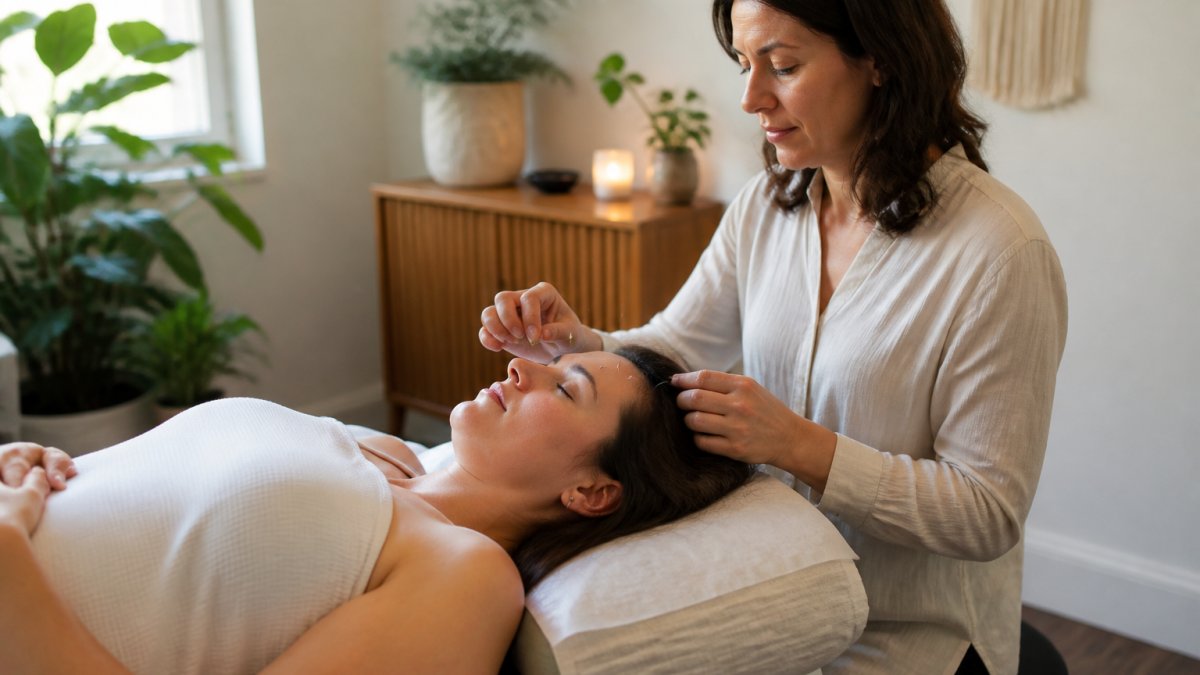
Acupuncture is generally well tolerated when performed by a licensed practitioner using sterile, single-use needles. The most common side effects are minor: temporary soreness, small bruises, or brief lightheadedness.
What a session typically involves. A first visit usually includes a health history, a review of your cycle and symptoms, and a physical exam of pulse and tongue in the traditional framework, followed by needle placement for roughly 20 to 30 minutes of rest. Subsequent visits are shorter.
How often treatment is typically considered. A common pattern is once or twice weekly for the first several weeks, then spacing out as symptoms change.
When changes might be assessed. Cycle-related outcomes need at least three cycles of data before a pattern is meaningful. Stress, sleep, and headache outcomes can be reviewed sooner, often at the four- to six-week mark, using simple logs. Decide in advance what you are measuring so the review is honest.
How to check practitioner qualifications. In most states, acupuncturists are licensed through a state board, and many hold national certification through the National Certification Commission for Acupuncture and Oriental Medicine (NCCAOM).
Plan a course, not a single session. Most patients need a series of visits over eight to twelve weeks before judging whether acupuncture is helping, and spacing sessions too far apart makes the answer impossible to read.
Acupuncture is not a substitute for clinician-led diagnosis or established PCOS care. Do not stop prescribed medication, skip monitored cycles, or delay medical evaluation of new or worsening symptoms to pursue acupuncture alone.
At Source Acupuncture, our licensed practitioners build PCOS treatment plans around your specific symptom profile, combining acupuncture with cupping, red light therapy, and stress-focused care as needed. Our wellness membership makes consistent sessions easier to sustain, which is what this condition actually requires.
Frequently Asked Questions
Can acupuncture help manage PCOS symptoms?
Research suggests acupuncture for PCOS may help with some symptoms, particularly irregular periods and stress, though results vary and the evidence is mixed. It is best viewed as a supportive treatment alongside standard medical care rather than a replacement. A 2019 systematic review found limited but encouraging evidence for cycle regulation and hormone markers. Because PCOS symptoms differ widely, a qualified practitioner should assess your specific pattern before recommending a treatment plan.
Can acupuncture help with PCOS-related irregular periods?
Some trials report improvements in menstruation rate and cycle regularity with acupuncture for irregular periods. A commonly cited review found that participants receiving acupuncture had a higher likelihood of restored menstruation compared with control groups, though study sizes were small and protocols varied. Acupuncture is not a guaranteed fix for irregular periods, and underlying conditions such as thyroid disorders should be ruled out by a physician first. Track your cycles for three to six months to measure progress objectively.
How many acupuncture sessions might be needed for PCOS?
Most clinical trials use weekly sessions over 8 to 12 weeks before assessing results, which is a reasonable starting frame for PCOS symptom management. Cycle changes typically take two to three menstrual cycles to become apparent. Some people notice stress and sleep improvements sooner, often within the first few visits. Discuss a trial period with your practitioner and set clear checkpoints so you can decide whether to continue based on measurable changes rather than guesswork.
Is acupuncture safe for people with PCOS?
Acupuncture is generally considered low risk when performed by a licensed practitioner using sterile single-use needles. Common side effects are minor, such as small bruises or temporary soreness at needle sites. People who are pregnant, taking blood thinners, or have bleeding disorders should tell their practitioner and physician before starting. Acupuncture should complement, not replace, prescribed medications or fertility treatment, and any changes to your care plan should be discussed with your doctor.
PCOS is a long-term condition, and managing it well takes more than one appointment. If irregular cycles, hormonal symptoms, or stress are running your life, we can help you build a plan you can stick with. Source Acupuncture offers personalized care for stress, hormones, and immune support, licensed practitioners, and a wellness membership program that makes regular treatment affordable. Get started with Source Acupuncture and build a consistent plan for your symptoms.