
Table of Contents
- How Acupuncture Works for Chronic Stress Relief
- The Science Behind Acupuncture and Stress Hormones
- Acupuncture Points for Stress and Anxiety Relief
- Benefits of Acupuncture for Mental Health and Chronic Stress
- How Often Should You Get Acupuncture for Stress Relief
- Acupuncture vs. Other Stress Relief Methods: What Works Best
- What to Expect During Your First Acupuncture Session
- Common Mistakes to Avoid When Seeking Acupuncture for Chronic Stress
Last Updated: July 21, 2026
Chronic stress has become one of the most persistent health challenges facing modern adults. Acupuncture for chronic stress relief offers a compelling alternative grounded in both ancient practice and contemporary research. At Source Acupuncture in Pacific Beach, San Diego, we’ve worked with hundreds of clients seeking natural ways to manage ongoing stress and restore nervous system balance.
How Acupuncture Works for Chronic Stress Relief
When fine needles are placed at specific points on the body, they trigger measurable changes in your nervous system, hormone levels, and brain chemistry. The practice rests on the traditional concept of qi (pronounced "chee"), the vital life force that flows through pathways called meridians. While Western medicine doesn’t use these exact terms, the meridian system correlates remarkably well with neural pathways and circulatory routes. When stress disrupts this flow, physical and emotional symptoms emerge. Acupuncture restores balance by clearing blockages and reactivating natural healing processes.
The Role of Meridians and Qi in Stress Response
Think of meridians as communication highways between your organs, nervous system, and brain. When you’re under chronic stress, these pathways become congested. Acupuncture needles act as reset buttons, interrupting the stress signal loop and prompting your body to clear the blockage. The liver meridian, for example, governs emotional regulation. Stress stagnates this meridian, leading to frustration and tension. Stimulating liver acupoints helps restore emotional equilibrium. Effects often build over multiple sessions rather than appearing instantly.
Nervous System Regulation: Sympathetic to Parasympathetic
Your nervous system has two main states: sympathetic (fight-or-flight) and parasympathetic (rest-and-digest). Chronic stress keeps you locked in sympathetic mode. Acupuncture shifts you into parasympathetic dominance by activating the vagus nerve, the master control switch for the parasympathetic system. Once activated, your body downregulates stress hormones, lowers heart rate, and returns to a state where healing can occur.
The parasympathetic system strengthens with repeated activation. Your first session might produce 20-30 minutes of calm. By session five or six, that calm extends for hours or days. By session twelve, many clients report a baseline shift where they’re less reactive to daily stressors.
Track your resting heart rate before and after your first three acupuncture sessions. You’ll likely see it drop by 5-10 beats per minute as your parasympathetic system activates.
The Science Behind Acupuncture and Stress Hormones
Chronic stress floods your body with cortisol and noradrenalin. These hormones are useful in short bursts but damage your immune system, disrupt sleep, impair memory, and accelerate aging when constantly elevated.
Cortisol Reduction and Endocrine System Balance
Cortisol is your primary stress hormone, released by the adrenal glands when your brain perceives threat. Under chronic stress, your cortisol curve flattens, staying high all day instead of spiking in the morning and dropping at night. This dysregulation is the root cause of insomnia, fatigue, and anxiety.
Acupuncture normalizes cortisol patterns by calming your nervous system and signaling your adrenal glands to stop pumping cortisol. Studies using saliva cortisol tests show that clients who receive regular acupuncture see cortisol levels drop by 20-30% within four weeks. The endocrine system responds like an orchestra to a conductor, when signals are clear, all instruments play in harmony. Cortisol drops, DHEA (the anti-stress hormone) rises, and your body chemistry rebalances. Source Acupuncture recommends a minimum commitment of 6-8 sessions before evaluating whether acupuncture is working for your specific stress profile.
Endogenous Opioids, Serotonin, and Neurochemical Shifts
Acupuncture triggers the release of endogenous opioids, your body’s natural painkillers and mood elevators. Serotonin, the neurotransmitter that regulates mood and resilience, also increases with acupuncture. Low serotonin is linked to depression, anxiety, and stress sensitivity. Acupuncture achieves a similar effect to SSRIs by stimulating the brain regions that produce serotonin naturally. Noradrenalin also normalizes as acupuncture reduces its production while simultaneously increasing the parasympathetic neurotransmitter acetylcholine.
Acupuncture works by simultaneously lowering stress hormones (cortisol, noradrenalin) while raising mood and calm molecules (endogenous opioids, serotonin, acetylcholine).
Acupuncture Points for Stress and Anxiety Relief
Certain acupoints have been used for thousands of years specifically because they reliably calm the nervous system.
Key Acupoints and Their Stress-Relief Functions
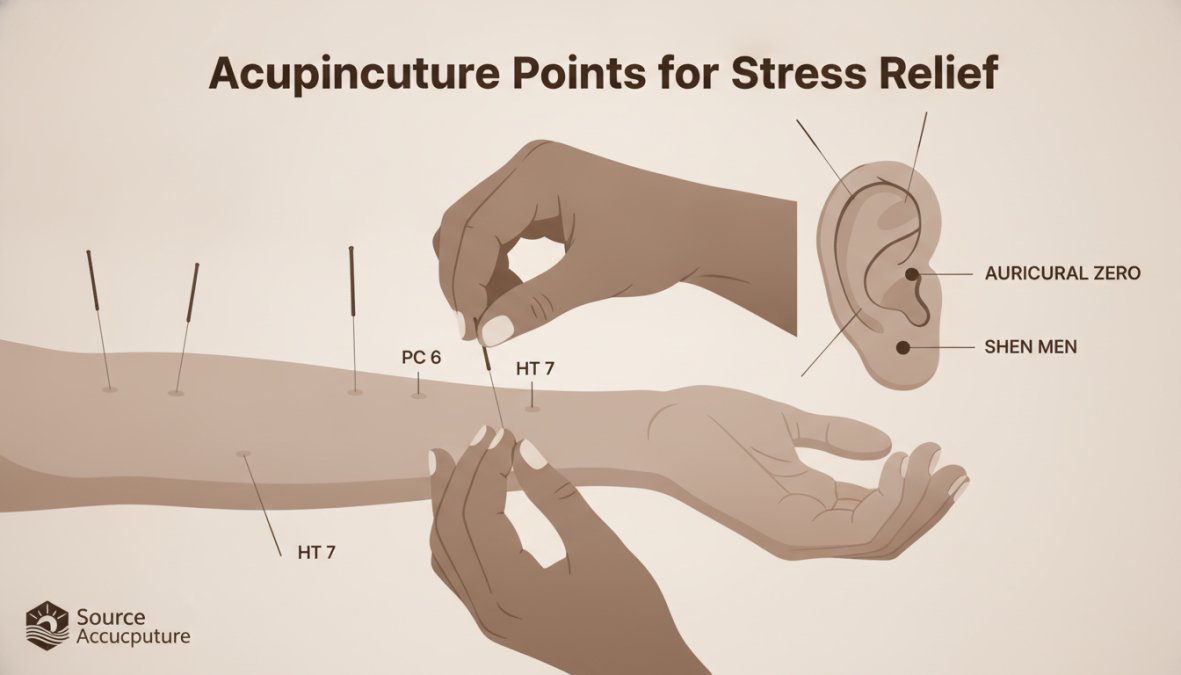
GV20 (Governing Vessel 20), located at the crown of the head, directly activates the parasympathetic system and is particularly effective for racing thoughts and mental overwhelm.
PC6 (Pericardium 6), located on the inner forearm two finger-widths above the wrist crease, is the go-to point for anxiety and panic.
LV3 (Liver 3), located on the top of the foot between the first and second toe bones, addresses stress that manifests as frustration, anger, or emotional rigidity.
HT7 (Heart 7), at the wrist crease on the pinky side, directly calms the heart and spirit when stress manifests as insomnia or racing heart.
SP6 (Spleen 6), located on the inner leg three finger-widths above the ankle bone, is a master point for calming the entire nervous system.
The ear contains dozens of acupoints that map to the entire body. The auricular shen men (spirit gate) point, located in the upper part of the ear canal, is perhaps the most universally calming acupoint.
Self-Acupressure Techniques for Immediate Relief
Acupressure, applying firm pressure with your fingers, activates the same points and can provide relief within minutes.
For acute anxiety: Locate PC6 on your inner forearm (two finger-widths above the wrist crease, between the two tendons). Press firmly with your thumb for 1-2 minutes while breathing slowly. Repeat on the other arm. Most people feel noticeably calmer within 3-5 minutes.
For racing thoughts: Find the top center of your head and press gently but firmly with your index finger for 2-3 minutes while imagining stress draining down through your body.
For frustration or anger: Locate LV3 between the first and second toe bones on the top of your foot. Press and massage this point for 2-3 minutes on each foot. Many people feel their jaw unclench and shoulders drop within minutes.
For insomnia: Find HT7 at the wrist crease on the pinky side and apply gentle but steady pressure for 1-2 minutes before bed. Combine with deep breathing: inhale for 4 counts, exhale for 6 counts.
These techniques work best when done consistently. A client who presses PC6 three times daily will see stress reduction compound over weeks.
Acupressure is not a substitute for professional acupuncture when dealing with [chronic stress](/how-to-stop-chronic-burnout/). Self-care bridges the gap between sessions and amplifies their effect, but it cannot replace the deeper nervous system recalibration that comes from needling.
Benefits of Acupuncture for Mental Health and Chronic Stress
After 8-12 sessions, many clients notice they’re less reactive to daily stressors. Your stress threshold rises, and your recovery time shortens. Emotional flexibility returns as acupuncture calms your baseline nervous system state.
Sleep improvements are often the first tangible benefit clients report. Within 2-3 sessions, many clients sleep more deeply and wake fewer times during the night. Better sleep then creates a positive feedback loop, as rested nervous systems handle stress more effectively.
Cognitive function sharpens as cortisol normalizes and mental fog lifts. Depression often accompanies chronic stress, and acupuncture addresses both by raising serotonin and endogenous opioids while restoring the capacity to experience pleasure. Acupuncture’s benefits compound over weeks and months as your nervous system is literally retrained to default to calm rather than vigilance.
How Often Should You Get Acupuncture for Stress Relief
Treatment frequency depends on whether you’re dealing with acute stress or chronic patterns that have built up over years.
Acute vs. Chronic Stress: Treatment Frequency Protocols
Acute stress responds quickly to acupuncture. You might need 3-4 sessions over 2-3 weeks to feel significant relief. Chronic stress requires a different approach. Your nervous system has learned to default to vigilance and needs repeated signals over weeks to unlearn this pattern. Most practitioners recommend 1-2 sessions per week for the first 4-6 weeks, then reassess.
Weeks 1-4 (Intensive Phase): 2 sessions per week to establish a new nervous system baseline.
Weeks 5-8 (Consolidation Phase): 1 session per week as your nervous system stabilizes the changes.
Weeks 9-12 (Maintenance Phase): 1 session every 2 weeks to reinforce the new baseline.
Beyond 12 weeks: Many clients shift to 1 session per month for ongoing maintenance, or as-needed when stress spikes.
A common mistake is stopping too early. Clients feel better after 4-6 sessions and assume they’re "fixed." Then stress gradually builds back up within 3-4 months.
Building Your Personalized Treatment Plan
The best treatment plan is one you’ll actually stick to. Work with your practitioner to design a realistic plan. Track your progress by noting your stress level on a 1-10 scale, sleep quality, anxiety frequency, and physical symptoms before starting, then reassess after 4 sessions and again after 8 sessions.
| Timeline | Frequency | Expected Outcomes |
|---|---|---|
| Weeks 1-4 | 2x/week | Reduced anxiety, better sleep, noticeable calm |
| Weeks 5-8 | 1x/week | Improved emotional regulation, sustained benefits |
| Weeks 9-12 | 1x/week | Resilience to stressors, stable baseline |
| Month 4+ | 1-2x/month | Long-term stress prevention, maintenance |
Acupuncture vs. Other Stress Relief Methods: What Works Best
You have options for managing chronic stress. Understanding how acupuncture compares helps you make an informed decision.
How Acupuncture Compares to Medication and Therapy
Medication (antidepressants, anti-anxiety drugs) works quickly but often brings side effects, and stopping medication usually brings stress symptoms roaring back because the underlying nervous system pattern hasn’t changed. Acupuncture works more slowly but creates lasting change, it takes 4-8 weeks to feel significant effects, but those effects persist long after you stop treatment because your nervous system has been retrained.
Therapy (cognitive-behavioral therapy, psychotherapy) is excellent for addressing the thoughts and beliefs driving stress, but it requires you to think your way out of a nervous system problem. Acupuncture and therapy are actually complementary. Acupuncture calms your nervous system so therapy can work more effectively.
Exercise burns off stress hormones and builds nervous system resilience, but it requires motivation and consistency, which chronic stress depletes. Acupuncture can restore enough calm and energy to make exercise sustainable. Meditation and breathwork are free and genuinely effective but require discipline and practice. Acupuncture jumpstarts the process by making your nervous system more receptive to these practices.
Cost-Benefit Analysis and Insurance Coverage
A single acupuncture session typically costs between a routine office visit and specialty care pricing. Frequency matters: 2 sessions weekly for 8 weeks (16 sessions) is a meaningful investment, but compare that to therapy (which typically requires weekly sessions indefinitely) or long-term medication. Many insurance plans cover acupuncture, especially when prescribed for pain or referred by a physician. Coverage varies widely.
Before starting acupuncture, call your insurance provider and ask: “Do you cover acupuncture for stress or anxiety? How many sessions per year? What’s my copay?”
What to Expect During Your First Acupuncture Session
Medical Screening and Contraindications
Your first session includes a health intake where the practitioner asks about your medical history, current medications, sleep, digestion, mood, and stress symptoms. This is diagnostic. Certain conditions require modified treatment or caution. If you’re on blood thinners, you may bruise more easily. If you have a pacemaker, some acupuncture points are off-limits. If you’re pregnant, certain points are contraindicated. A qualified practitioner screens for these contraindications before needling. Acupuncture is remarkably safe when performed by a licensed practitioner, serious complications are rare, roughly 1 in 200,000 treatments.
The Treatment Experience and Recovery
A typical session lasts 45-60 minutes. The practitioner inserts hair-thin needles at selected points. The needles stay in place for 20-30 minutes while you rest. Most people experience a sensation called "deqi", a dull ache or tingling at the needle site that indicates the point is activating. Many clients fall asleep during needle retention.
After needles are removed, you’ll feel remarkably calm. Some clients describe it as a "reset." This calm typically lasts several hours. You may feel slightly fatigued for the rest of the day as your body shifts into parasympathetic mode. Drink extra water and avoid strenuous exercise for 24 hours. Some clients experience a temporary increase in symptoms in the 24-48 hours after treatment, which passes quickly.
Common Mistakes to Avoid When Seeking Acupuncture for Chronic Stress
Expecting instant results. Your nervous system didn’t become dysregulated overnight. Commit to 6-8 sessions before evaluating whether it’s working.
Inconsistent attendance. Missing sessions breaks momentum. Consistency matters more than frequency.
Not communicating with your practitioner. If a particular acupoint is uncomfortable or you’re not sleeping better after three sessions, tell your practitioner. Treatment plans should evolve based on your response.
Continuing behaviors that drive stress. Acupuncture calms your nervous system, but if you’re working 70-hour weeks, sleeping 5 hours, and drinking five cups of coffee, no amount of acupuncture will create lasting peace.
Choosing based on price alone. Practitioner skill, experience with stress-related conditions, and the quality of the treatment space matter.
Stopping too early. Clients feel dramatically better after 8 sessions and assume they’re "done." Within 3-4 months, stress gradually rebuilds. Maintenance sessions prevent regression.
Not addressing lifestyle. Acupuncture works best alongside better sleep, movement, nutrition, and stress reduction practices.
Chronic stress is one of the most treatable conditions, yet millions suffer unnecessarily because they haven’t found the right approach. Acupuncture for chronic stress relief offers a pathway to retrain your nervous system itself rather than just managing symptoms. At Source Acupuncture in Pacific Beach, our practitioners specialize in personalized stress protocols, flexible wellness memberships, and consistent care that produces lasting change. Get started with Source Acupuncture today and experience what genuine nervous system reset feels like.
Frequently Asked Questions
How does acupuncture help with chronic stress?
Acupuncture for chronic stress works by stimulating specific acupoints that signal your nervous system to shift from a sympathetic (fight-or-flight) state to a parasympathetic (rest-and-digest) state. This needling activates endogenous opioids and increases serotonin production, reducing cortisol levels and promoting deep relaxation. The practice also improves heart rate variability (HRV), a marker of nervous system resilience. Evidence-based research shows verum acupuncture (true needling) produces measurable changes in stress hormones and circulation.
What are the best acupuncture points for stress and anxiety?
Key acupoints for stress relief include Heart 7 (HT7), located on the wrist crease, which calms the mind and promotes sleep; Governing Vessel 20 (GV20), at the crown of the head, which lifts mood and clears mental fog; and Liver 3 (LV3), on the foot, which regulates qi flow and reduces tension. Ear acupuncture, particularly the Shen Men point, is highly effective for acute anxiety. A licensed practitioner will assess your meridian imbalances and select acupoints tailored to your stress presentation, whether it manifests as physical tension, racing thoughts, or emotional dysregulation.
How often should you get acupuncture for chronic stress relief?
For chronic stress, most evidence supports weekly sessions for the first 4-6 weeks to establish nervous system rebalancing, then tapering to bi-weekly or monthly maintenance. Acute stress may benefit from 2-3 sessions weekly initially. Frequency depends on stress severity, your body's response, and whether you combine acupuncture with self-acupressure and lifestyle changes. A personalized treatment protocol from your practitioner will specify the optimal schedule for your needs. Consistency matters more than occasional sessions for lasting relief.
Is acupuncture for chronic stress covered by insurance?
Insurance coverage for acupuncture varies widely by plan and state. Many plans now cover acupuncture for pain conditions, but coverage for stress and mental health is less common. Check your policy or contact your insurer directly. Many wellness centers, including Source Acupuncture, offer membership programs that provide deep discounts on regular sessions, making consistent treatment more affordable. This approach can be more cost-effective than relying on insurance reimbursement, especially if you need ongoing sessions for chronic stress management.
External Sources Referenced
[EXTERNAL_LINK: National Center for Complementary and Integrative Health research on acupuncture mechanisms | nccih.nih.gov]
[EXTERNAL_LINK: Frontiers in Neuroscience study on acupuncture and parasympathetic activation | frontiersin.org]
[EXTERNAL_LINK: Journal of Acupuncture and Tuina Science review of acupoint protocols for stress relief | springer.com]
This article was written using GrandRanker