Last Updated: November 1, 2026
Quick Summary
Acupuncture for chronic lower back pain causes targets the underlying problem, since mechanical, nerve, inflammatory, and lifestyle factors each respond differently to needling. Muscle strain, disc herniation, facet irritation, spinal stenosis, and sacroiliac dysfunction are common causes, and nonspecific low back pain is the largest single category in most clinics.
- Chronic lower back pain is defined as lumbar discomfort lasting 12 weeks or longer.
- Nonspecific low back pain, with no structural cause on imaging, is the largest single category in most clinics.
- The strongest evidence supports short-term pain relief compared with no treatment or usual care.
- Seek prompt care for loss of bladder or bowel control, saddle numbness, or progressive leg weakness.
- A common course is once or twice weekly for several weeks, then tapering as symptoms settle.
Table of Contents
- Causes of Chronic Lower Back Pain and Why They Matter
- How Acupuncture Helps Back Pain: Mechanisms and Muscle Effects
- Acupuncture Research for Back Pain: What the Evidence Shows
- Acupuncture for Lower Back Pain: Points Used and What a Session Involves
- Risks, Red Flags, and When to See a Doctor
- Treatment Course, Cost, and Realistic Expectations
- Booking Your First Acupuncture Session for Back Pain
- Frequently Asked Questions
Causes of Chronic Lower Back Pain and Why They Matter
Chronic lower back pain is generally defined as discomfort in the lumbar spine that persists for 12 weeks or longer (Chronic Low Back Pain in Adults: Evaluation and Management). The cause shapes everything about how you should treat it, and identifying it is the first step in deciding on any treatment.
The distinction matters more than most people realize. Two patients can describe identical pain and have completely different underlying problems. In fact, the largest single category in most clinics is nonspecific low back pain, pain with no identifiable structural cause on imaging. That label is not a dismissal; it is a signal that the nervous system, muscle guarding, sleep, stress, and load management matter more than a scan result.
Mechanical and Structural Causes
Mechanical causes involve the moving parts of the lumbar spine: muscles, ligaments, discs, facet joints, and the bony canal. The most common specific ones include:
- Muscle strain and ligament sprain, often from repeated lifting, a single awkward lift, or deconditioning. Pain typically worsens with specific movements and eases with rest or position changes.
- Disc degeneration and disc herniation, age-related disc wear is common and often painless; a herniation that irritates a nerve root produces sharper, radiating pain rather than a dull central ache.
- Facet joint irritation (facet arthropathy), pain that is often worse with extension (leaning back) and prolonged standing.
- Spinal stenosis, narrowing of the spinal canal that classically produces pain, heaviness, or cramping in the legs with walking and relief with sitting or leaning forward.
- Sacroiliac joint dysfunction, pain localized to one side of the low back or buttock, often worse with standing on one leg or rolling over in bed.
- Spondylolisthesis, a vertebra slipping forward on the one below, which can narrow the canal and mimic stenosis.
These produce pain that is usually mechanical, it changes with posture, load, and movement. That pattern is useful because it tells us which tissue to target with needling and which movements to modify.
Inflammatory, Nerve, and Lifestyle Causes
Nerve involvement changes the picture. Pain that radiates down a leg, burns, or tingles suggests a nerve root is being irritated rather than a muscle being strained. Inflammatory conditions, including axial spondyloarthritis and other rheumatologic disease, can produce persistent morning stiffness and pain that improves with activity rather than rest. These are medical diagnoses first; acupuncture may support symptom management but does not replace rheumatology care.
Lifestyle and psychosocial factors are not soft add-ons. Prolonged sitting, deconditioning, poor sleep, stress, and fear of movement all drive persistent pain and all influence how a patient responds to treatment.
Why the Cause Changes the Acupuncture Approach
Knowing which category you fall into determines whether needling should target tight musculature, surrounding nerve pathways, or the broader nervous system. A patient with a guarded, spasming erector spinae responds to local needling and twitch responses; a patient with radicular symptoms needs a more cautious approach and coordination with their physician; a patient with nonspecific chronic pain often benefits most from a course that addresses the nervous system and graded return to activity. Acupuncture does not diagnose these causes, and it does not treat every one of them equally, which is exactly why the assessment comes first.
The article groups the main causes of chronic lower back pain and notes how each typically presents.
| Cause | Typical pattern |
|---|---|
| Muscle strain and ligament sprain | Worse with specific movements, eases with rest |
| Disc degeneration and disc herniation | Herniation gives sharper, radiating pain |
| Facet joint irritation | Worse with extension and prolonged standing |
| Spinal stenosis | Leg heaviness or cramping with walking, relief sitting |
| Sacroiliac joint dysfunction | One-sided low back or buttock pain |
| Spondylolisthesis | Vertebra slips forward, can mimic stenosis |
| Nonspecific low back pain | No identifiable structural cause on imaging |
How Acupuncture Helps Back Pain: Mechanisms and Muscle Effects
Acupuncture for back pain works through several proposed pathways rather than one. The most cited involve the central nervous system: fine needling is thought to trigger the release of endorphins and other natural opioids, which modulate how pain signals are transmitted. Separate research points to local effects at the needle site, including increased circulation and reduced inflammation.
The muscle effects are what many patients notice first. Needling into a taut band of muscle can produce a local twitch response, followed by tension release and improved mobility in the surrounding tissue. For anyone whose lumbar pain comes with muscle spasms, that relaxation is often the most immediate change.
Acupuncture is best viewed as a complementary therapy, not a replacement for medical care.
Acupuncture Research for Back Pain: What the Evidence Shows
The research on acupuncture for back pain is meaningful but not settled, and the honest summary is more useful than either hype or dismissal. Some systematic reviews have reported that acupuncture may produce greater symptom reduction than usual care alone for chronic low back pain, particularly for pain intensity, though the evidence is mixed and the strength of the findings varies.
What the Evidence Actually Supports
The strongest and most consistent finding is short-term pain relief compared with no treatment or usual care. Function, your ability to sit, stand, walk, and lift, improves in many trials, but the functional signal is smaller and less consistent than the pain signal. That distinction matters: a treatment that lowers pain but does not change what you can do is a different value proposition than one that restores activity. (Source: American College of Rheumatology guidelines for axial spondyloarthritis)
Effect Size, Sham Needling, and Uncertainty
Here is the part most summaries skip. Acupuncture outperforms sham acupuncture in many trials, but the gap is often smaller than the gap between acupuncture and no treatment. That pattern suggests part of the benefit comes from the treatment experience itself, expectation, attention, relaxation, the ritual of care, and part from the needling. This therapeutic massage approach similarly leverages the physiological and psychological impact of human touch to address the underlying mechanisms of persistent lumbar discomfort.
Effect sizes vary widely across studies, and trial quality is inconsistent. Blinding is difficult because patients can often tell whether they received real needling, and practitioner skill and point selection vary between trials. We read the evidence as support for a time-limited trial of care with clear reassessment, not as a guarantee.
How We Use the Evidence in Practice
We treat this as complementary therapy, not a replacement for medical care. That means setting a realistic checkpoint: if pain and function have not improved meaningfully after a defined course, we change the plan or refer you back to your physician rather than simply adding sessions. Readers weighing it against other options can see how acupuncture compares to physical therapy for back pain, and our article on how acupuncture supports muscle activation goes deeper on the muscular side.
Acupuncture for Lower Back Pain: Points Used and What a Session Involves
Acupuncture sessions generally include a brief intake and assessment before treatment, and point selection is typically individualized.
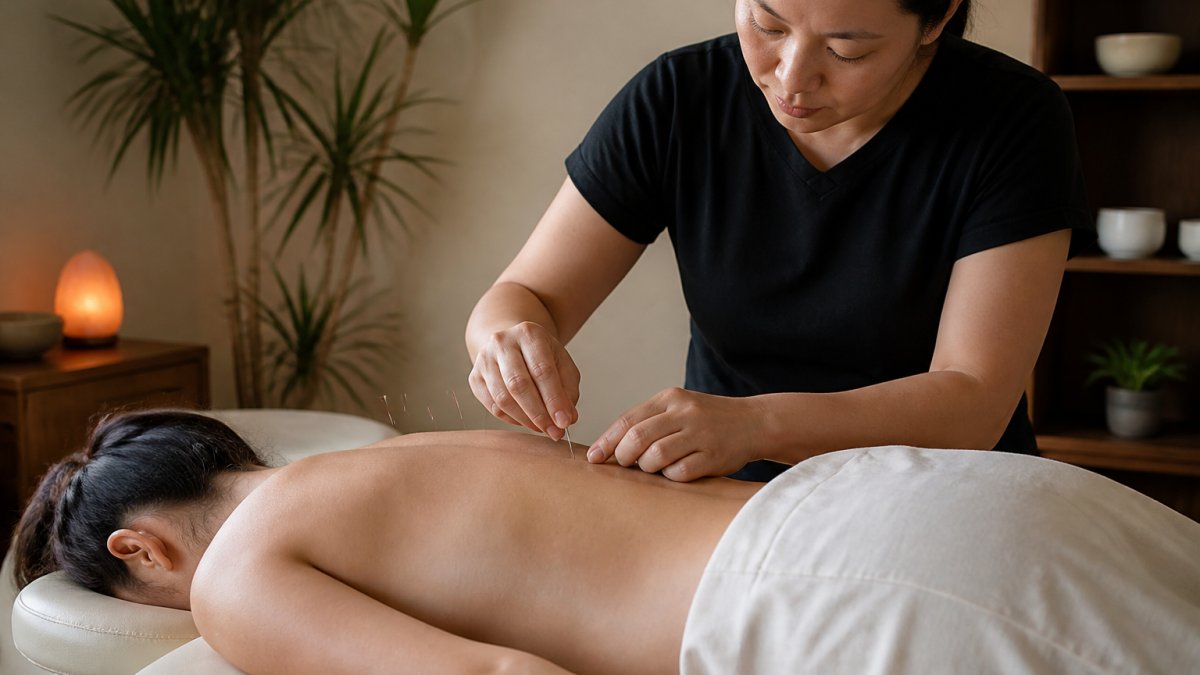
Commonly used points in acupuncture for back pain sit in the lower back musculature beside the lumbar spine, in the glutes and hips, and along the back of the legs when nerve symptoms are present. Many people report a mild ache or heaviness rather than sharp pain.
Risks, Red Flags, and When to See a Doctor
Acupuncture is generally well tolerated, with the most common adverse effects being minor bruising or soreness at needle sites. Serious complications are rare. Choosing a licensed practitioner who uses sterile, single-use needles is an important safety consideration.
Watch out: some back pain needs medical evaluation before any complementary treatment. Seek care promptly for loss of bladder or bowel control, numbness in the groin or saddle area, progressive leg weakness, fever with back pain, or pain following significant trauma. These can signal conditions that need urgent assessment.
Screening for contraindications, including bleeding disorders and anticoagulant use, is an important part of any safe acupuncture assessment, and coordination with your physician is advisable when needed.
Treatment Course, Cost, and Realistic Expectations
Acupuncture for chronic pain is usually delivered as a course rather than a single visit. A common approach is once or twice weekly for several weeks, then tapering as symptoms settle. Some people respond within the first few sessions; others need longer. Treatment frequency should match your response and your schedule.
Cost varies by provider and visit length, and insurance coverage for acupuncture is inconsistent. For current prices and coverage questions, contact Source Acupuncture directly or check with your insurer, or review how much acupuncture costs. For current prices and coverage questions, contact Source Acupuncture directly or check with your insurer.
Booking Your First Acupuncture Session for Back Pain
The most useful first step is a proper assessment: what is causing your pain, what has already been tried, and what a realistic course looks like.
Source Acupuncture offers acupuncture, cupping, and red light therapy, and provides a wellness membership program. If you are ready to address the cause rather than just the symptom, book a session to discuss your options.
Frequently Asked Questions
Can acupuncture help chronic lower back pain?
Acupuncture for lower back pain is a complementary option that some people consider, and some clinical studies have reported modest reductions in pain intensity. It does not work for everyone, and results vary by cause, how long the pain has lasted, and treatment frequency. Most people judge it alongside physical therapy and medical care rather than instead of them. A licensed practitioner can assess whether your presentation suits needling.
What are the common causes of chronic lower back pain?
Persistent lumbar pain usually traces to muscle strain, degenerative disc or joint changes, facet joint irritation, or nerve compression such as a pinched nerve. Lifestyle factors including prolonged sitting, weak core muscles, poor sleep, and stress amplify pain signals through the central nervous system. Inflammatory conditions and referred pain from other organs are less common but matter because they change treatment. Knowing which category you fall into is what makes any therapy, acupuncture included, more likely to help.
How many acupuncture sessions may be needed for chronic back pain?
Many people begin with a short course of sessions, often once or twice weekly, and review progress along the way to see whether pain intensity and mobility are changing. Chronic pain that has lasted months rarely resolves in one visit. If you notice no meaningful change after a fair trial, that is useful information, and a good practitioner will say so rather than extend the course indefinitely. Discuss frequency with your clinician.
What does research say about acupuncture for chronic low back pain?
Some reviews of clinical studies have reported modest pain relief for chronic low back pain, though findings vary across studies. Sham acupuncture controls also show some benefit, which suggests expectation and placebo contribute. Evidence quality is limited by small samples and difficulty blinding. The honest read is that acupuncture is reasonable as part of a broader plan, not a guaranteed standalone cure.
When should lower back pain be evaluated by a healthcare professional?
Seek medical evaluation promptly for red flags: loss of bladder or bowel control, numbness in the groin or saddle area, progressive leg weakness, fever with back pain, unexplained weight loss, pain after significant trauma, or pain that is worse at rest and at night. These can signal nerve compression, infection, or fracture. Ordinary chronic lumbar pain without these signs can often be managed conservatively, but any new or worsening neurological symptom warrants a doctor’s assessment first.