Table of Contents
- Acupuncture vs Chiropractic: Quick Comparison
- How Chiropractic Adjustments for Athletes Work
- How Acupuncture for Sports Injury Recovery Works
- Key Differences in Treatment Approach
- How Often Should Athletes Get Acupuncture
- Cost, Insurance, and Recovery Timeline Comparison
- When to Choose Each Modality or Use Both
- Frequently Asked Questions
Last Updated: September 22, 2026
Acupuncture vs Chiropractic: Quick Comparison
When athletes get injured, two conservative modalities often come up: acupuncture and chiropractic care. Both address pain without surgery but work through different mechanisms. Understanding when to use each, or both, is critical for recovery.
The core difference: Chiropractic focuses on spinal alignment and joint mobility to restore nervous system function. Acupuncture targets soft tissue tension and inflammation by stimulating the nervous system and improving blood flow. Most athletes benefit most from whichever addresses their primary dysfunction, or both, sequenced strategically.
| Aspect | Acupuncture | Chiropractic |
|---|---|---|
| Primary focus | Soft tissue tension, inflammation, nervous system regulation | Spinal alignment, joint mobility, biomechanics |
| Mechanism | Neurological stimulation, blood flow improvement | Structural correction, nervous system optimization |
| Best for | Chronic pain, repetitive strain, systemic inflammation | Acute misalignment, postural dysfunction, range of motion |
| Typical session length | 30-60 minutes | 15-30 minutes |
| Frequency for acute injury | 1-2 times per week initially | 2-3 times per week initially |
| Insurance coverage | Variable (often less covered) | More commonly covered |
How Chiropractic Adjustments for Athletes Work
Chiropractic care restores spinal alignment and joint mobility. Misaligned vertebrae restrict nerve function and limit range of motion, directly impacting athletic performance and injury risk.
Chiropractic adjustments apply controlled force to restore joint position, reducing nerve interference and restoring normal biomechanics. This improves movement patterns and reduces compensatory strain.
Spinal misalignment creates muscular tension as the body stabilizes the unstable joint. Once alignment is restored, muscular guarding relaxes, the nervous system functions without interference, and blood flow improves.
Chiropractic adjustments are particularly effective for acute injuries involving impact or trauma, and for postural dysfunction from poor ergonomics or repetitive movement.
Athletes often benefit most from chiropractic care in the first 2-4 weeks after an acute injury, when structural misalignment is the primary problem. As acute inflammation resolves, acupuncture becomes more valuable for addressing residual soft tissue tension and preventing re-injury.
How Acupuncture for Sports Injury Recovery Works
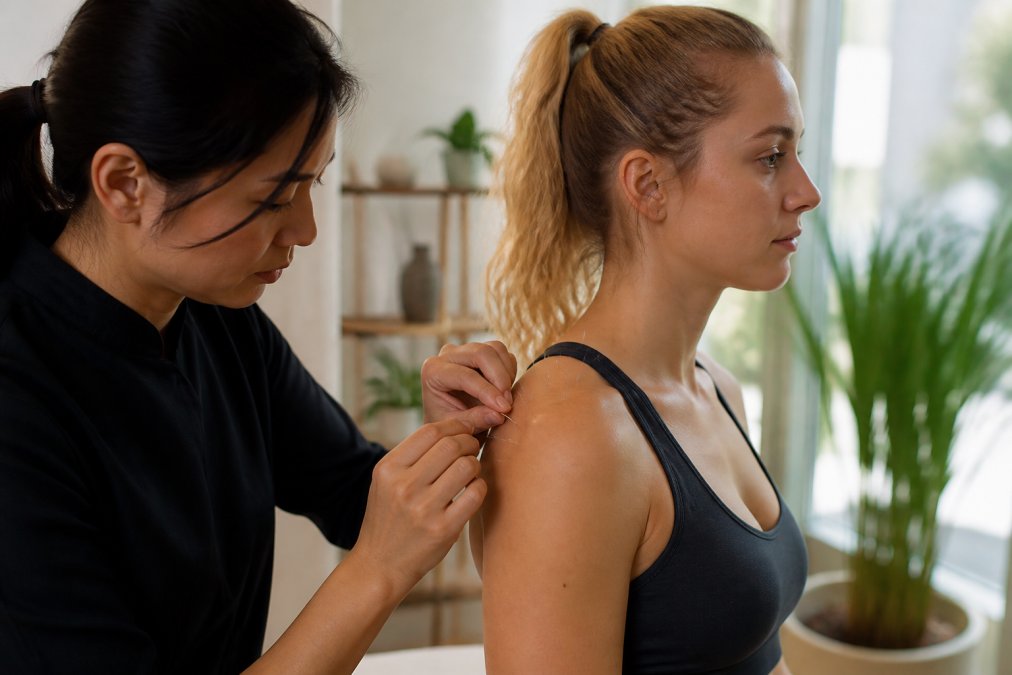
Acupuncture stimulates the nervous system and triggers localized blood flow, addressing soft tissue tension, inflammation, and pain signaling that persist after initial injury healing.
Needle insertion creates microtrauma that triggers increased circulation, bringing oxygen and nutrients to accelerate healing. Stimulation interrupts pain signals and retrains the nervous system to stop perceiving threat in that tissue.
Acupuncture is particularly valuable for chronic pain and repetitive strain where structural alignment is normal but soft tissue dysfunction persists, directly targeting myofascial restrictions.
Acupuncture also works systemically, regulating the nervous system and reducing inflammation, which is why athletes use it to optimize recovery and prevent future dysfunction.
Key Differences in Treatment Approach
Chiropractic is structural, addressing alignment and joint mobility. Acupuncture is functional, addressing soft tissue tension, inflammation, and nervous system dysregulation.
A herniated disc causing nerve compression responds better to chiropractic adjustment. A chronic muscle knot responds better to acupuncture when structural alignment is normal.
Both work through the nervous system differently: chiropractic removes mechanical interference; acupuncture actively stimulates to downregulate pain and inflammation.
Chiropractic typically requires 2-3 visits per week initially, then tapers. Acupuncture follows a similar pattern but can be maintained longer because its effects are cumulative.
A common mistake is expecting either modality to work in isolation for complex injuries. A shoulder injury involving both postural misalignment (chiropractic issue) and chronic rotator cuff tension (acupuncture issue) requires both. Using only one extends recovery unnecessarily.
How Often Should Athletes Get Acupuncture
Acupuncture frequency depends on injury severity and treatment stage. Unlike chiropractic’s immediate structural change, acupuncture works cumulatively, so consistency matters more than intensity.
Acute Injury Phase (Weeks 1-4)
For acute sports injuries, most athletes benefit from 1-2 sessions per week initially to interrupt pain signaling and accelerate blood flow during the critical early healing window.
Subacute and Chronic Phase (Weeks 4-12)
Once acute inflammation subsides, 1 session per week maintains nervous system retraining and addresses residual soft tissue tension. For chronic pain or repetitive strain, 1 session per week is standard.
Recovery Plateau and Maintenance (Week 12+)
Once acute dysfunction resolves, maintenance sessions every 2-4 weeks prevent recurrence and sustain nervous system changes.
Why Consistency Matters More Than Intensity
A single session provides temporary relief; cumulative sessions drive durable recovery. Inconsistent spacing breaks the nervous system’s learning curve and extends recovery time.
Most athletes notice measurable improvement within 3-4 sessions. If no change occurs by session 4, the modality may not fit that injury or the protocol needs adjustment.
Frequency Adjustments Based on Injury Type
Frequency adjusts by injury type: acute joint sprains (2/week for 2-3 weeks, then 1/week for 4-6 weeks); muscle strains (1-2/week for 4 weeks, then 1/week for 4 weeks); chronic soft tissue tension (1/week for 8-10 weeks); repetitive strain (1/week for 8-12 weeks); post-surgical (1-2/week for 6-8 weeks, then 1/week for 4-6 weeks).
Combining Acupuncture Frequency with Other Modalities
A typical integrated protocol: Weeks 1-4 (2 chiropractic + 1 acupuncture/week); Weeks 5-8 (1 chiropractic + 1 acupuncture/week); Weeks 9-12 (1 acupuncture every 2 weeks + chiropractic as needed).
This sequence allows chiropractic to restore alignment while acupuncture addresses soft tissue dysfunction, without overwhelming the body’s recovery capacity.
Missing even one or two sessions in the early phase (weeks 1-4) can extend total recovery time by 2-4 weeks. The nervous system learns through repetition, and gaps in treatment interrupt that learning curve. If you cannot commit to consistent weekly sessions, discuss a modified protocol with your practitioner before starting treatment.
Tracking Progress and Adjusting Frequency
Progress should be measurable by session 4. Track pain level, range of motion, sport-specific movement ability, and sleep quality. If metrics improve 20-30%, continue current frequency. If less than 10%, discuss protocol adjustments with your practitioner.
At 80-90% recovery, transition to maintenance: 1 session every 2-4 weeks to prevent re-injury.
Cost, Insurance, and Recovery Timeline Comparison
Insurance Coverage
Chiropractic is more commonly covered by health insurance. Most major plans include chiropractic benefits with typical coverage of 20-50 visits per year and copays of $20-$50 per visit.
Acupuncture coverage has expanded significantly since 2020, when the Centers for Medicare & Medicaid Services added acupuncture to the Medicare benefit for chronic lower back pain. However, private insurance coverage remains inconsistent. Roughly 60% of major health plans now include acupuncture, but many limit coverage to 12-20 visits per year and require a diagnosis of chronic pain. Out-of-pocket costs for acupuncture typically range from $60 to $150 per session without insurance, compared to $30 to $100 for chiropractic adjustments, depending on provider credentials and location.
Out-of-Pocket Costs and Session Frequency
For uninsured athletes, the cost difference becomes material over a full recovery cycle. An acute sports injury typically requires:
- Chiropractic: 8-12 visits over 4-6 weeks at $50-$100 per visit = $400-$1,200 total
- Acupuncture: 6-10 sessions over 6-8 weeks at $75-$150 per session = $450-$1,500 total
- Combined approach: 6-8 chiropractic visits + 4-6 acupuncture sessions = $800-$2,000 total
The combined approach costs more upfront but often shortens total recovery time, potentially reducing the number of sessions needed for each modality.
Recovery Timeline by Injury Type
Recovery speed varies significantly by injury and which modality is used.
| Injury Type | Chiropractic Alone | Acupuncture Alone | Combined (Chiro First, Then Acupuncture) |
|---|---|---|---|
| Acute ankle sprain (Grade 1-2) | 3-4 weeks | 4-6 weeks | 2-3 weeks |
| Acute lower back strain | 2-4 weeks | 3-5 weeks | 2-3 weeks |
| Chronic IT band syndrome | 6-10 weeks | 6-8 weeks | 4-6 weeks |
| Shoulder impingement (chronic) | 8-12 weeks | 6-8 weeks | 5-7 weeks |
| Neck strain from poor posture | 3-5 weeks | 4-6 weeks | 2-4 weeks |
| Repetitive strain (tennis elbow, golfer’s elbow) | 6-10 weeks | 5-8 weeks | 4-6 weeks |
Why the Combined Approach Often Costs Less Overall
If you’re budget-constrained and your injury involves both structural misalignment and soft tissue tension, start with chiropractic to restore alignment, then add acupuncture for the final 4-6 weeks of recovery. This sequence typically costs less than either modality alone and produces faster results than sequential single-modality treatment.
Insurance Claim Strategy
When to Choose Each Modality or Use Both
Choose chiropractic if:
- Your injury involves acute misalignment (recent trauma, fall, heavy lift)
- Your pain is positional or movement-pattern related
- You have postural dysfunction or range-of-motion loss
- Your insurance covers chiropractic care
Choose acupuncture if:
- You have chronic soft tissue tension or trigger points
- Your pain persists after structural issues are resolved
- You deal with repetitive strain injuries
- You want to optimize nervous system recovery and inflammation reduction
Use both if:
- Your injury involves both structural misalignment and soft tissue dysfunction
- Your recovery has plateaued with one modality alone
- You’re an athlete managing multiple recurring issues
- You want to accelerate recovery and prevent future injuries
The ideal sequence for most sports injuries is chiropractic first to restore alignment, then acupuncture to address residual soft tissue tension. Once acute dysfunction resolves, maintenance acupuncture prevents re-injury while chiropractic visits taper.
American Chiropractic Association guidelines on sports injury management
National Institutes of Health research on acupuncture mechanisms
Frequently Asked Questions
Do professional athletes use acupuncture for recovery?
Yes, many professional athletes incorporate acupuncture into their recovery protocols. Acupuncture for sports injury recovery addresses soft tissue tension, inflammation, and nervous system regulation, factors that affect athletic performance. Athletes often use it alongside other modalities to manage pain and accelerate healing after intense training or competition.
Is acupuncture more effective than chiropractic care for sports injuries?
Effectiveness depends on the injury type and your specific needs. Chiropractic adjustments excel at restoring spinal alignment and joint mobility, which benefits structural issues. Acupuncture targets soft tissue tension, inflammation reduction, and nervous system function. Many athletes benefit most from both approaches used together, addressing different aspects of recovery.
How often should athletes get acupuncture for best results?
Frequency depends on injury severity and training intensity. Acute injuries may benefit from 1-2 sessions per week initially, while maintenance for chronic issues or general recovery might involve bi-weekly or monthly sessions. A qualified practitioner can assess your condition and recommend a schedule tailored to your athletic goals and recovery needs.
Does health insurance cover acupuncture or chiropractic care?
Coverage varies by plan and state. Many insurance plans cover chiropractic adjustments for certain conditions, though coverage limits and copays differ. Acupuncture coverage is expanding but remains less universal. Check your specific policy or contact your insurer to understand what’s covered. Some athletes use wellness memberships as a cost-effective alternative.