
Table of Contents
- How Acupuncture for Tendonitis Works
- Acupuncture for Chronic Pain Relief: What the Evidence Says
- Acupuncture Recovery Time for Tendonitis: What to Expect
- Acupuncture vs Physical Therapy for Tendonitis
- Is Acupuncture Safe for Tendonitis? Contraindications and Risks
- Cost, Commitment, and What to Ask Before You Book
- Frequently Asked Questions
Last Updated: September 16, 2026
How Acupuncture for Tendonitis Works
When patients ask is acupuncture worth it for chronic tendonitis, the answer starts with what the treatment actually is: a treatment approach that uses fine, sterile needles inserted at specific points to influence blood flow, nerve signaling, and the body’s own repair response around an injured tendon.
Tendonitis, more accurately called tendinopathy, is a breakdown of the collagen structure inside a tendon rather than simple inflammation. That distinction matters. A tendon that has been irritated for months needs circulation, load management, and time, not just a painkiller.
The Role of Therapeutic Needles and Meridian Points
The therapeutic needles used in acupuncture are hair-thin and inserted at meridian points, which are mapped locations along connective tissue planes. Modern research frames the effect differently than traditional theory does: needle insertion creates a small, controlled stimulus that triggers local vasodilation, releases neurochemicals involved in pain modulation, and prompts a mild healing response in the surrounding soft tissue.
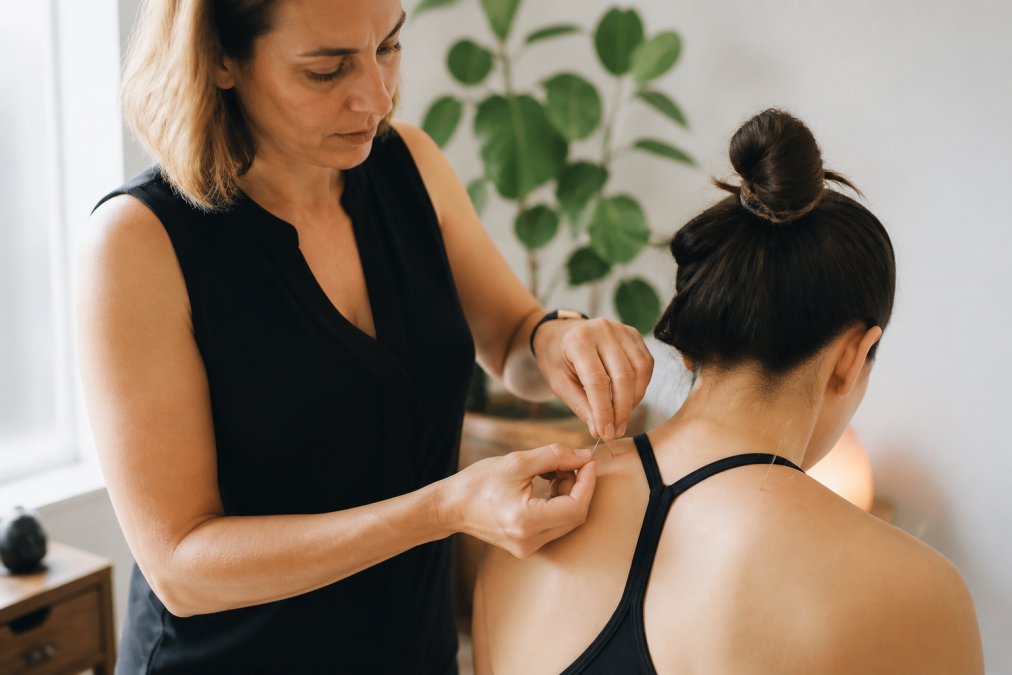
Needle placement for tendonitis rarely targets the tendon itself. Skilled practitioners work the surrounding muscle bellies and trigger points, because a tendon under constant tension from a tight muscle cannot settle down.
Acupuncture for Chronic Pain Relief: What the Evidence Says
Acupuncture for chronic pain relief has a real but bounded evidence base, and the honest version of that story is more useful than either the hype or the dismissal. The strongest signal comes from large reviews that pool many trials together rather than from any single study.
Here is the shape of what the research actually shows:
- Versus no treatment or a waitlist: acupuncture consistently reduces chronic musculoskeletal pain by a clinically noticeable margin. This is the comparison where the effect is largest and most reliable.
- Versus sham needling: the gap shrinks. Some trials still favor real acupuncture, others find little difference. This is the finding skeptics point to, and it is a fair point.
- Versus usual care alone: adding acupuncture to a conventional plan tends to improve pain scores and function modestly, which is the scenario most tendonitis patients are actually in.
The reason the sham comparison matters for tendonitis specifically: tendinopathy is a slow collagen remodeling problem, not a simple pain signal. A needle cannot rebuild a tendon. What it may do is lower the pain enough that you can load the tendon through physical therapy, and loading is what actually changes tendon structure. That makes acupuncture a potential enabler of the treatment that works, not a replacement for it. Similar physiological mechanisms are often explored when considering whether cold plunge therapy provides a comparable bridge to the mechanical loading required for long-term tissue recovery.
For context on how mainstream medicine frames this, the National Center for Complementary and Integrative Health overview of acupuncture summarizes the clinical picture without overselling it, and peer-reviewed summaries indexed through PubMed Central’s musculoskeletal pain research reach similar conclusions.
What does that mean practically for a chronic tendon?
- If you expect one session to erase months of pain, you will be disappointed.
- If you expect a low-risk addition that may reduce pain enough to let you do your rehab exercises, the case is reasonable.
- If you have tried it for six to eight weeks with no change in pain or function, the evidence does not support pushing on indefinitely. Reassess.
Track two numbers, not one: your pain score at rest and your pain score during activity. Acupuncture can lower the first while the second barely moves, and it is the second number that tells you whether the tendon is actually tolerating load again.
One more nuance the top-ranking articles tend to skip: the placebo question cuts both ways. If part of the benefit comes from expectation, relaxation, and the ritual of a calm treatment, that is still a benefit you experienced, but it also means results are less predictable, and it is a reason to judge your own response over four to six weeks rather than trusting someone else’s testimonial.
Acupuncture Recovery Time for Tendonitis: What to Expect
Acupuncture recovery time for tendonitis varies widely, and anyone promising a fixed timeline is guessing. Chronic tendinopathy typically responds over weeks, not days. Most practitioners suggest a short initial course of sessions spaced close together, then a tapering schedule as symptoms settle.
A realistic pattern many patients experience:
- Weeks 1-2: sessions once or twice weekly, with mild soreness for a day after needling
- Weeks 3-6: gradual reduction in baseline pain, better tolerance for daily activity
- Beyond week 6: maintenance sessions, often monthly, alongside a strengthening program
If pain is worsening session over session, or you develop sharp pain, swelling, or numbness that was not there before, stop and get evaluated. Acupuncture is not a substitute for imaging or a proper diagnosis when something is structurally wrong.
Acupuncture vs Physical Therapy for Tendonitis
Acupuncture vs physical therapy for tendonitis is not really a fair fight, because the two do different jobs. Physical therapy builds load tolerance and strength in the tendon. Acupuncture addresses pain and circulation so you can actually do the loading work.
| Approach | Primary Goal | Typical Frequency | Best Used For |
|---|---|---|---|
| Acupuncture | Pain modulation, circulation | 1-2x weekly, tapering | Calming a flare, enabling movement |
| Physical therapy | Strength, load tolerance | 1-2x weekly plus home work | Rebuilding tendon capacity |
| Combined | Both of the above | Coordinated schedule | Chronic cases that stall alone |
Is Acupuncture Safe for Tendonitis? Contraindications and Risks
Acupuncture is generally well tolerated when performed by a licensed practitioner using sterile, single-use needles. Adverse effects are usually minor: small bruises, brief soreness at insertion sites, and occasional lightheadedness during treatment.
Contraindications and cautions worth knowing:
- Blood thinners or bleeding disorders raise bruising and bleeding risk
- Anticoagulant use should be disclosed before your first session
- Avoid needling over infected, inflamed, or broken skin
- Pregnancy requires modified point selection and practitioner disclosure
- Pacemakers and implanted electrical devices matter if electro-stimulation is planned
Cost, Commitment, and What to Ask Before You Book
Cost-benefit is where most acupuncture articles go quiet, and it is the exact question behind whether is acupuncture worth it for chronic tendonitis. Here is the practical version.
- Some health plans include acupuncture for chronic pain, and a growing number of plans have added it as a covered benefit for specific conditions.
- Medicare Part B covers acupuncture for chronic low back pain under defined circumstances, which tells you the mainstream system treats it as legitimate for at least some musculoskeletal pain, but that coverage does not automatically extend to tendonitis (Acupuncture coverage).
- Many plans still exclude acupuncture entirely or require it be performed by a specific type of licensed provider.
- If you have an HSA or FSA, acupuncture is often an eligible expense even when insurance will not pay, which effectively lowers your after-tax cost.
Before you book anywhere, ask these questions:
- How many sessions do you typically recommend before we reassess, and what does that reassessment look like?
- What is the total estimated cost of that initial course, all-in?
- Do you provide a superbill or receipt I can submit to my insurer or HSA?
- Do you combine acupuncture with any other modality, and is that included in the price?
- What is your cancellation and rebooking policy?
- Are your practitioners licensed, and what is their training background?
- Do you offer a package or membership, and what are the terms if I stop using it?
The single most useful question is not “how much per session” but “what is the total plan, what will it cost all-in, and when will we reassess whether it is working.” That reframes the decision around outcomes and total spend rather than price per needle.
Frequently Asked Questions
How many acupuncture sessions are typically needed for chronic tendonitis?
Most treatment protocols for chronic tendonitis involve a series of sessions rather than a single visit. A common approach starts with one to two sessions per week for several weeks, then tapers as symptoms improve. The exact number depends on how long you have had the condition, which tendon is involved, and how you respond. Some people notice less pain after three or four sessions, while chronic cases may need eight to twelve. Ask your practitioner for a reassessment point so you can judge progress objectively.
When is acupuncture not recommended for tendonitis?
Acupuncture is generally avoided over infected skin, open wounds, or areas with active inflammation from an acute injury. It is also used with caution in people who take blood thinners, have bleeding disorders, or have a implanted electronic device near the treatment site. If you are pregnant or have a compromised immune system, tell your practitioner before treatment. A qualified provider will review your health history and may adjust the treatment protocol or refer you to a physician if acupuncture is not appropriate.
Can acupuncture help with specific types like peroneal tendonitis?
Acupuncture is used for many tendonitis locations, including the peroneal tendons on the outside of the ankle. Needles are placed at local points around the tendon and at distal points along the meridian. Because the peroneal tendons handle a lot of biomechanical stress during walking and running, treatment often combines acupuncture with load management and strengthening. Results vary by individual, so a clinical assessment is the best way to determine whether acupuncture fits your recovery plan.
How does acupuncture compare to physical therapy for tendonitis?
Physical therapy focuses on loading, strengthening, and movement patterns to rebuild tendon capacity. Acupuncture focuses on pain modulation, blood circulation, and reducing muscle tension around the affected tendon. Many people use both: acupuncture for pain relief and physical therapy for functional improvement. A combined approach often works better than either alone for chronic tendonitis, especially when the tendon has not responded to rest and anti-inflammatory medication.
What does a typical acupuncture session for tendonitis involve?
A session usually starts with a brief assessment of your pain, range of motion, and health history. The practitioner then inserts fine needles at selected points around the affected tendon and along related meridians. Needles stay in for 20 to 30 minutes while you rest. Some practitioners add electro-stimulation to enhance the effect. After treatment, you may feel relaxed or slightly sore. Most people return to normal activities right away, though strenuous use of the affected tendon should wait until your practitioner clears it.